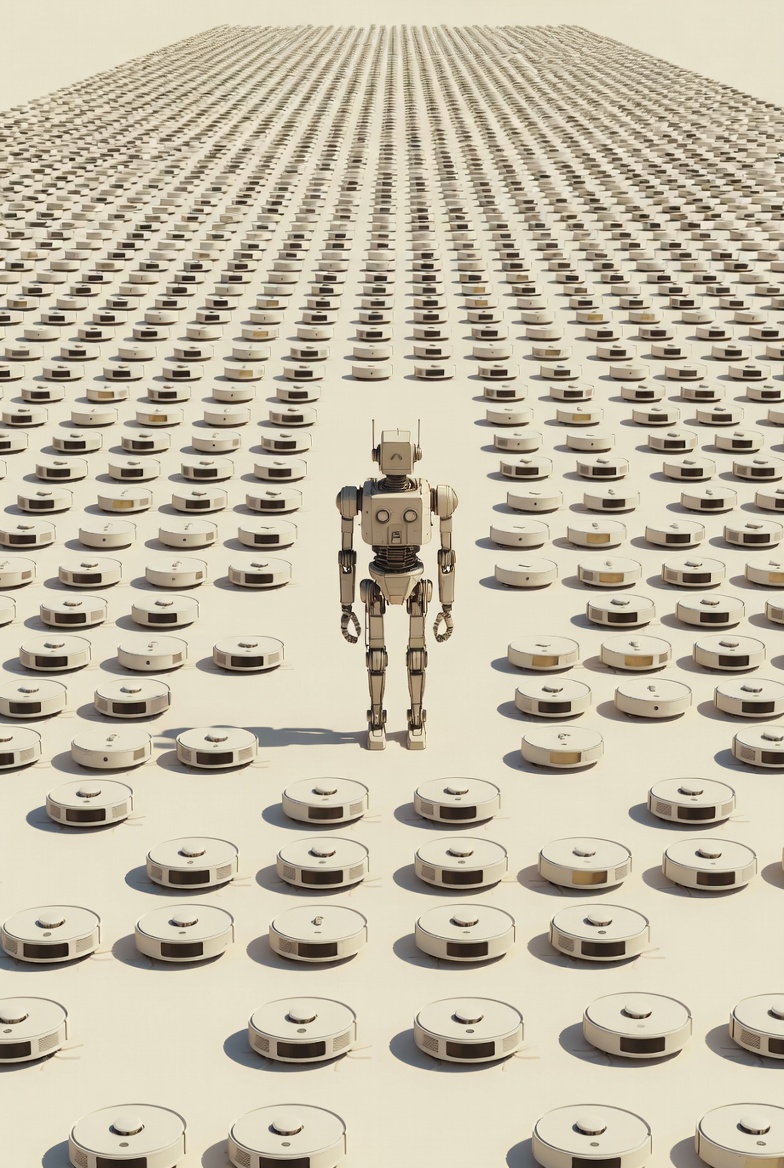
The headline number is real. What it counts is the interesting part.
China’s customs authority reports that the country exported robots worth close to 20 billion yuan — roughly $2.98 billion — in the first five months of 2026, shipped to more than 150 countries. State media has framed this as evidence of a high-end manufacturing ascent: the moment Chinese robotics stopped filling domestic factories and started competing globally, humanoids and all.
Read the breakdown, though, and the composition tells a quieter story. Cleaning robots — floor scrubbers, robotic vacuums, the domestic-appliance end of the category — account for around 14 billion yuan of that total. More than seventy percent of the “robot export boom” is machines that bump around living-room floors. The figure is independently consistent: in the first quarter, customs put cleaning robots at 68.5% of robot export value, a proportion confirmed by CGTN and carried across the state wire. The trend held into May.
The humanoids — the machines the framing invites you to picture — are in there, but they are a rounding error by comparison. The customs data logs “intelligent bionic robots,” the category humanoid-adjacent machines fall into, at more than 8,000 units exported over the five months. That is a real number and a growing one. It is also a very small tail on a very large dog.
There is a subtler reason the humanoid figure looks like a sudden arrival. “Intelligent bionic robots” and “cleaning robots” are new customs tariff codes, introduced in 2026. A deputy director general at Wujiang Customs described the shift plainly: robot classifications have moved from broad categorisation to refined classification, with dedicated codes added as segments mature. Which means some of the visible “surge” in humanoid exports is not more robots crossing borders — it is the same robots being counted in their own box for the first time. A category that did not exist in the data last year will always look explosive in its debut year.
Then there is the value question, which cuts against the upgrade narrative most directly. State commentary presents the export growth as China moving from low value-added to high value-added products. The unit economics say otherwise. In April, industrial-robot export volume rose 89% year on year while export value rose barely one percent — implying an average exported unit price of about 37,000 yuan. Over the same month, China imported industrial robots at an implied average of roughly 97,000 yuan each. The country is exporting cheap robots in bulk and still importing the expensive ones. That is a cost-competitiveness story, which is a genuine and formidable thing to be. It is not, yet, the premium-tier story the “high-end upgrade” language describes.
None of this makes the export figure hollow. Cleaning robots are a real product category, competitively made, and China dominates it — that dominance is worth reporting on its own terms. The localisation of core components is real too: China’s own agencies put humanoid core-component localisation above 75% as of early 2026, and the supply chain has visibly deepened. The point is narrower, and it is about what a single aggregate number conceals. Twenty billion yuan of “robots” invites a picture of Apollo-class humanoids streaming off container ships. The customs breakdown shows something closer to a very large number of robot vacuums, a modest and growing trickle of humanoids counted freshly for the first time, and an industrial-robot trade in which China still buys up the sophisticated end.
The boom is real. It is mostly on the floor.