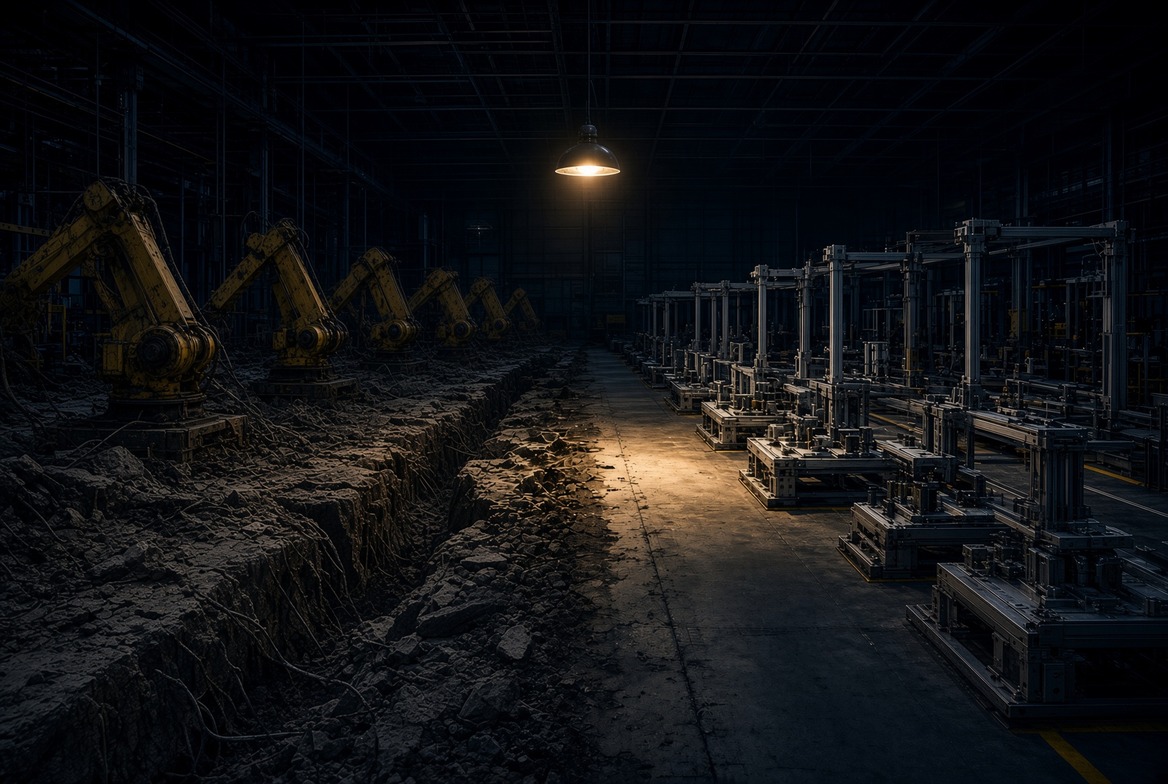
On 10 July 2026, Tesla announced it had finished demolishing the Model S and Model X assembly line at its Fremont factory — forty-six days after the last of either car left it. Between them, the two models had run for a combined twenty-five years and built more than 610,000 vehicles. The floor space is now Optimus’s. Tesla says the humanoid robot began production there in late August.
Musk has called Optimus “the hardest product to scale manufacturing that we’ve ever made at Tesla,” a striking claim from the company whose Model 3 ramp in 2018 was dubbed “production hell” and became a byword for manufacturing crisis in its own right. Optimus doesn’t get to borrow any of the Model 3’s advantages. It runs on roughly 10,000 unique parts, almost none of which had an existing supplier when the programme started — Tesla is building the components, the tooling and the process simultaneously, inside a building that was assembling cars five months ago.
Here is the number sitting next to that one. Musk predicted “roughly 10,000” Optimus units for 2025. None of them did useful work. As of January 2026, by Tesla’s own account, zero Optimus units were performing productive tasks anywhere. The long-run design target for the new Fremont line is capacity for up to a million robots a year — a figure that currently describes a building that has been running for weeks, making a product whose maker says its own output rate is “impossible to predict.”
Tesla calls the near-term plan “Optimus Academy”: robots built at Fremont doing routine tasks on Tesla’s own factory floor before anyone outside the company sees one do a job. It’s a sound method — train the robot where a mistake costs an afternoon, not a customer. It’s also the same method nearly every other humanoid maker in this publication’s pages has used to close the identical gap: put the robot to work somewhere the stakes are low, and let the sales pitch catch up to the demonstration once the demonstration is real.
None of this makes the teardown fake. Tearing out concrete trenches and robotic tooling for a fourteen-year production line is an expensive, irreversible thing to do on a bluff, and Tesla did it. What a converted factory floor buys is capacity — the physical ability to build robots at volume, if the robots turn out to be worth building. It does not buy capability, and the distance between those two words is exactly where this publication has found nearly every humanoid robotics claim it has checked so far.
Two truths: Tesla really did demolish a line that built 610,000 cars to make room for this — and the robot moving into that space has yet to complete a single day’s paid work anywhere.
Distance to Spare Key: not applicable this issue. There’s no capability demonstration here to score — only a production-capacity claim. Scoring a factory conversion against the six-axis rubric would dress up a supply-chain story as a capability one, which is the exact confusion this piece is about.