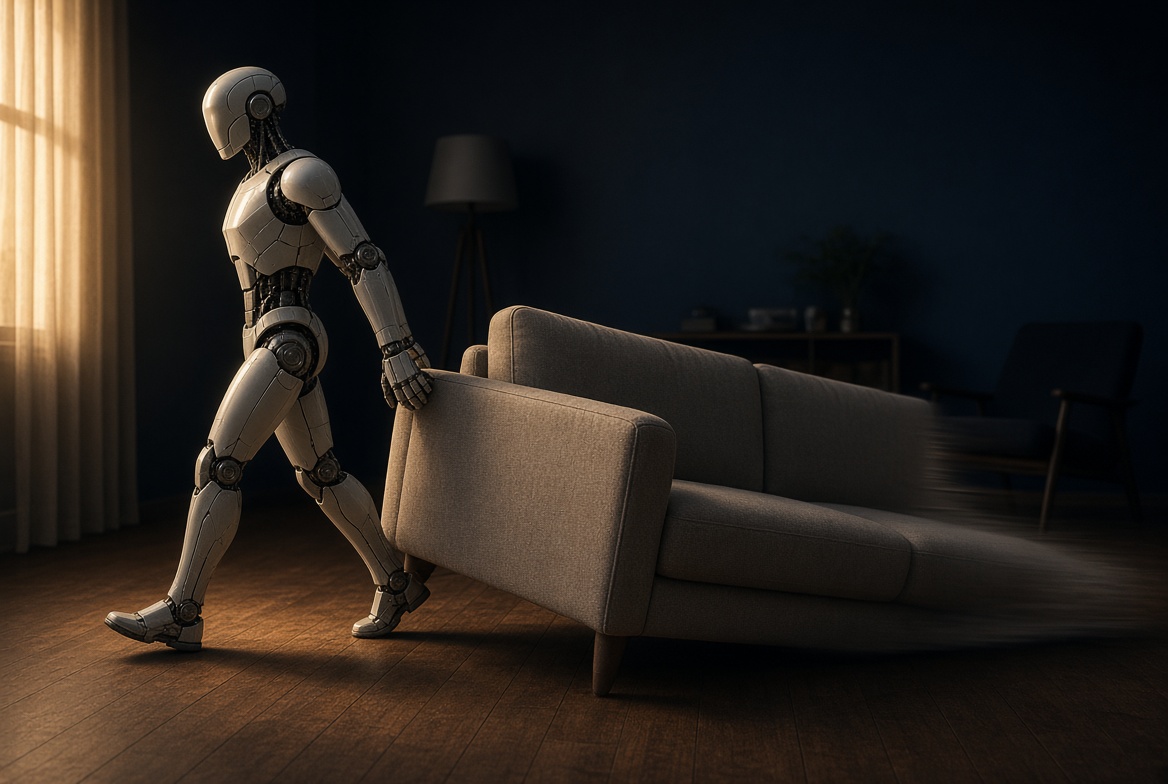
Agility Robotics posted a video this week of its Digit V5 humanoid dragging a couch across a living room floor, then moving chairs and clutter out of the way — the kind of furniture rearranging a moving-company temp does on their first day. IEEE Spectrum’s Evan Ackerman, whose Video Friday roundup has covered enough choreographed robot demos to be skeptical by default, called it a little bit silly but conceded the couch drag in this one is impressive. TechEBlog described it more plainly as a demonstration of generalized manipulation — objects of different sizes, weights, and grips, moved through a space built for people, not pallets.
The V5 platform this ships on has grown since Agility’s last generation: payload capacity is up to 50 pounds from 35, arm reach now extends to 7.2 feet, and Agility says a charge lasts roughly 20 hours. Inside is Nvidia’s IGX Thor compute stack and Agility’s own Halos safety platform, which the company says uses onboard cameras and sensors to monitor the humans working nearby it.
What neither outlet says is how much of the couch-dragging was Digit deciding what to grab and how, versus a person driving it through the motions from off camera. That is not a small omission. A robot that identifies a couch, plans a drag path around furniture, and adjusts its grip for an object it was not specifically programmed to move is a different machine than one following a scripted or teleoperated sequence for the cameras. Both are worth showing. They are not the same claim, and the video does not say which one this is.
This is also, so far, a small story: two outlets picked it up, not the wire-service pile-on that followed the Unitree IPO run or the Games medal count. That is itself a data point. A robot moving a couch in a living room is closer to the actual promise of a home humanoid than a warehouse tote count, and it drew a fraction of the coverage that flashier, more scripted demos get. The gap between what would matter and what gets attention is not new here. It is just, this week, a couch.