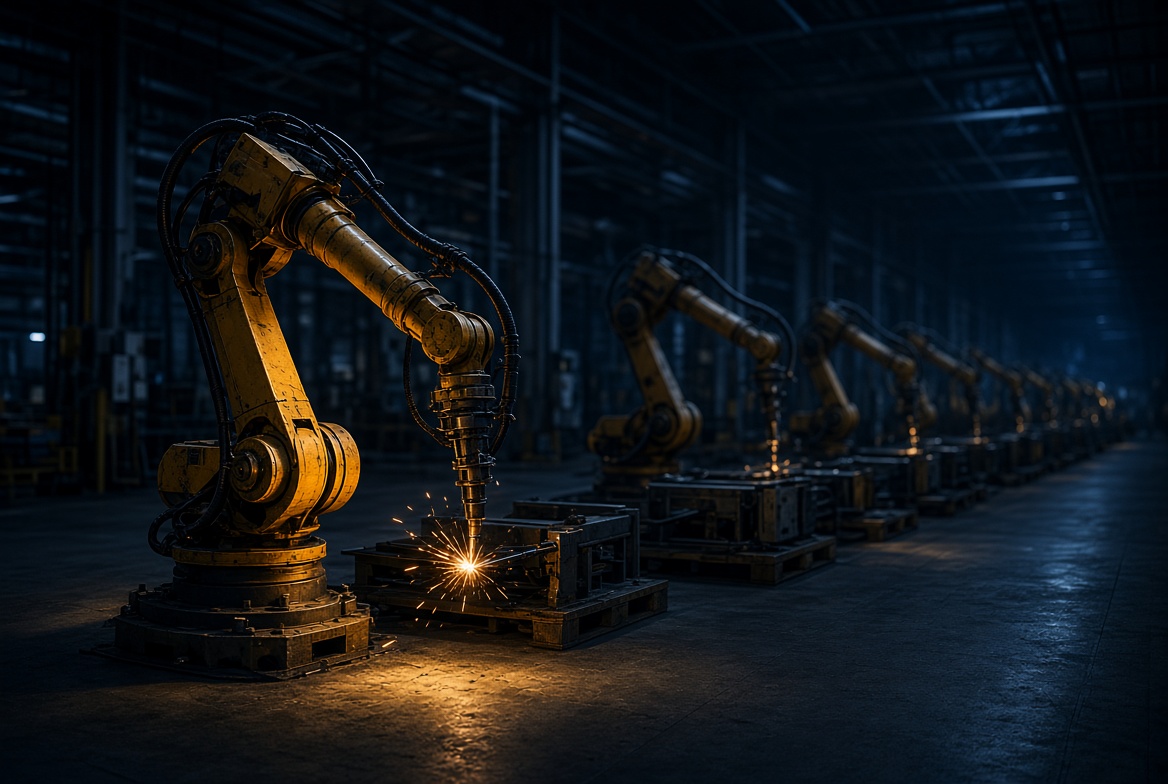
The International Federation of Robotics published its 2026 World Robotics report this week, and the headline number has nothing to do with humanoids: the global operational stock of industrial robots crossed five million units in 2025, roughly double the total from seven years ago. Manufacturers installed more than 600,000 new robots last year alone — an 11% increase, the first time annual installations have topped 600,000 — with China accounting for 354,000 of them, 59% of the global total and up 20% on 2024. The United States overtook Japan for second place with just under 38,500 new installations; Japan fell to third, down 19%. “Industrial automation is progressing at high speed,” IFR president Jane Heffner said, in a report that spends nearly all of its length on robots that do not walk on two legs.
Humanoids get one much smaller line: roughly 7,000 full-size units sold worldwide for industrial and professional use in 2025. That figure has not moved much since this publication last cited it. What has moved is the gap between it and how the category gets talked about. Boston Dynamics — majority-owned by Hyundai since 2021, and the subject of this publication’s own valuation piece last week — has reportedly pushed back its long-rumoured IPO on the grounds that Atlas remains unprofitable and undeployed at meaningful scale: the company most of the industry studies, sitting out the market it is credited with creating. Unitree, whose Shanghai listing this publication has tracked since August, is down more than 50% from its post-IPO peak.
The sharper number arrived separately, from the consultancy Arthur D. Little. Its Blue Shift unit sizes the entire “physical AI” market — industrial robots, warehouse automation, humanoids, all of it — at $18 billion today, on a path to $60–100 billion by 2030. Humanoids account for $2–3 billion of that $18 billion: real money, but a sliver of it. Dr Albert Meige, the unit’s director, states the mismatch without much hedging: humanoid “real-world value lags their hype,” while the returns that do exist are going to narrower systems built for one job in one warehouse. The report goes further than most on where the hype comes from, stating that “many demonstrations are pre-programmed, remotely operated or even totally AI-generated” — not an accusation levelled at one company, but a description offered of an entire category’s marketing output.
None of this makes the five million industrial robots any less real. They are welding, palletising and picking in facilities that will never post a demo video, and their number is growing faster than at any point on record. It just means two different stories are running side by side under one “robots are taking over” headline: one steady and boring and compounding, the other still mostly selling the promise of what a demo shows.
Two truths: five million industrial robots are already working, growing faster than ever, in the least photogenic parts of manufacturing — that part is not hype. And a meaningful share of the humanoid footage generating headlines next to that number is, by one credible analyst’s own account, not footage of a real robot doing a real job.