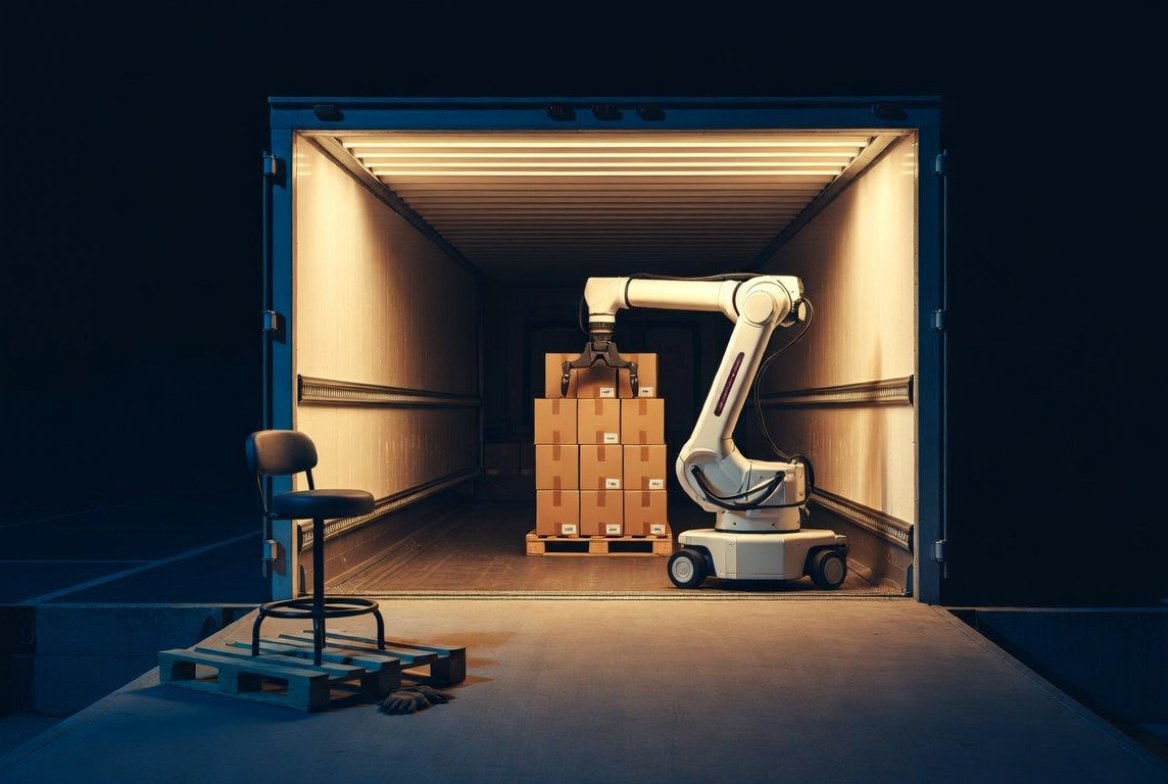
Boston Dynamics has launched the second generation of Stretch, its wheeled robot that unloads boxes from the back of a trailer. The headline figure is up to 1,000 cases an hour. The company’s own caveat arrives in the same breath: the real rate depends on how heavy the cases are and how neatly they were stacked.
The more interesting number is smaller. Boston Dynamics says it studied more than 100,000 operating hours to find what took the first Stretch out of service, then redesigned around those faults. About 81% of the internal cabling is gone. The swerve drive unit that reportedly took a full day to replace now swaps in about an hour. The emergency stop sits lower and recessed, and new exterior panels are meant to stop a falling box triggering a needless safety halt. Brian Donnelly, the company’s vice-president and general manager of logistics robotics, put it plainly: the focus was “the things that actually took robots offline in the real world.”
That is what a product sounds like when it has left the demo stage. A machine that has unloaded tens of millions of boxes is being fixed by people who know where it breaks. It is also being made serviceable by someone else: the company says onboard diagnostics put more routine maintenance in the hands of the customer’s own team. Whoever buys one inherits a fleet to look after.
What the announcement leaves out is the useful part. No price. No unit count. No ship date for Gen 2. No figure for how many dock workers any of this replaces. One report names DHL and Hermes as customers; the other names nobody. DHL did sign a memorandum of understanding in May 2025 covering more than 1,000 additional robot units across its divisions, but an MOU is an intention, not an order, and the Stretch announcement says nothing about where that stands.
Note what Stretch is not. It has wheels, not legs, and it does one job. That may make it a more telling sign of where automation is heading than most humanoid demos, because it is unglamorous and it is already working in loading docks while the humanoids collect the investment.
Two truths: a robot rebuilt around its own failure data, serviced by the customer and sold into one of logistics’ most punishing jobs, is a more serious piece of automation than most humanoid demos. But a peak throughput claim with no price, no fleet count and no staffing figures tells you what the robot can do on a good day, not what it does to the people on the dock.
Sources: Manufacturing.net (4 November 2026); Drives & Controls (6 November 2026); Boston Dynamics and DHL Group announcements of the May 2025 memorandum of understanding.