Field Notes · Humanoid Robotics
After summiting a 6,200-metre volcano — with a little help from its handlers — a humanoid called Pemba has Everest in its sights. The gap between the headline and the reality tells you exactly where the field actually is.
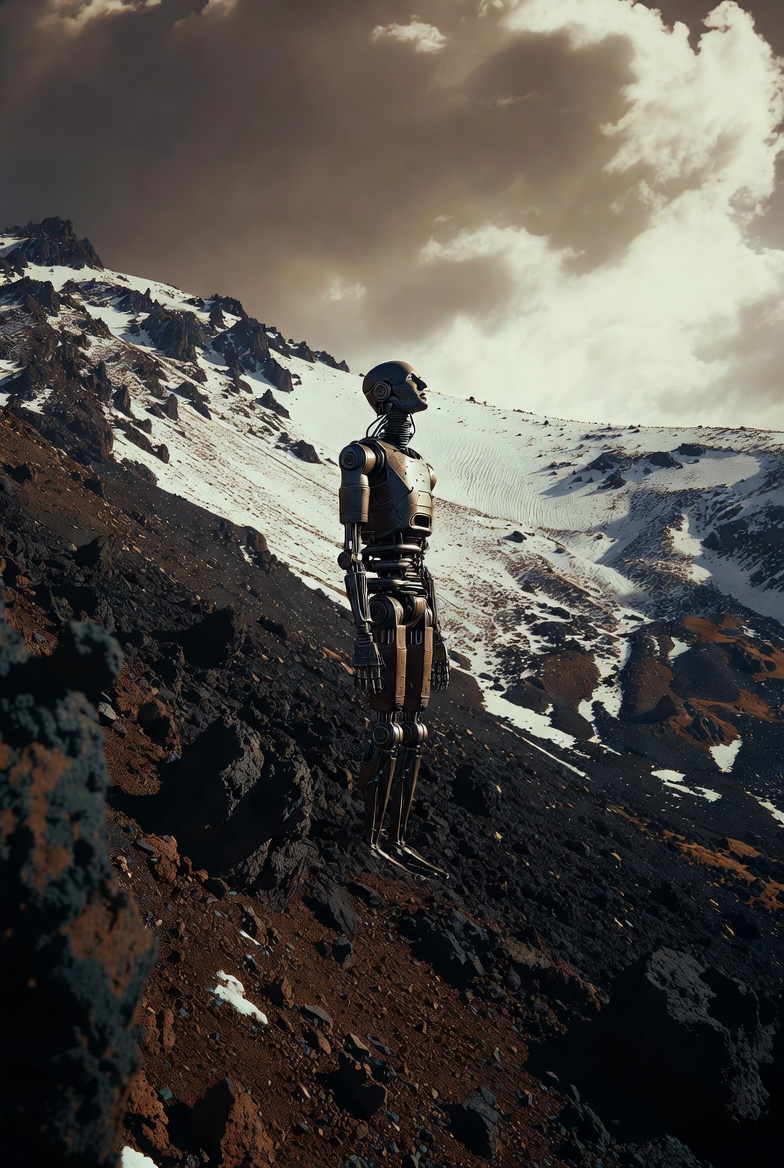
A modified Unitree G1 humanoid called Pemba has reached the summit of Chimborazo — Ecuador’s highest peak at 6,200 metres (20,341 feet) — becoming the first humanoid robot to climb to that altitude. The team behind it, a US-registered non-profit called Geologic Dome working with Nepal-based Fourteen Peaks Expedition, is now targeting Everest. The story broke yesterday and the coverage has been predictably breathless.
Worth slowing down.
What actually happened
The Chimborazo climb took 16 hours. On sections with gradients under 30 degrees, Pemba walked under its own control. On the steeper, technically demanding sections — the parts that actually make a mountain difficult — expedition members carried the robot. This is not a minor footnote. The ascent of a serious peak is defined by precisely those steep, exposed sections. Everything below 30 degrees is a walk-in.
“The goal now is to gradually expand the robot’s autonomous capabilities through reinforcement-learning systems trained to handle increasingly difficult terrain.”
That sentence from the project team is doing a lot of work. What it means in practice is: Pemba cannot currently handle the terrain that constitutes a real mountaineering challenge. The team knows this. To their credit, they haven’t tried to hide it.
The engineering problems are real and hard
The Chimborazo attempt exposed two categories of difficulty that are genuinely interesting from an engineering standpoint.
The first is locomotion. Reinforcement learning has produced remarkable results in controlled and semi-controlled environments — the Beijing half-marathon in April, where over 100 humanoid teams competed and the winner finished in under 51 minutes, was a landmark demonstration. But a flat urban course and a 50-degree ice slope are not the same problem. The latter involves dynamic load-shifting, unpredictable surface compliance, and consequences for failure that a warehouse floor does not have.
The second is thermal. Electronics and batteries at extreme altitude face freezing temperatures, rapid thermal cycling, and degraded cooling efficiency. The Pemba team developed custom thermal management systems integrated into the robot’s clothing — which is, in its own quiet way, a more interesting engineering achievement than the summit photo.
The bureaucratic problem is also real
The team had originally planned an Everest attempt during the 2026 spring climbing season. It hasn’t happened — not because the robot wasn’t ready (it clearly wasn’t), but because Nepal has no legal framework for robotic expeditions. The Department of Tourism has requested the development of rules, fees, and guidelines for what officials are apparently calling “non-human climbers” before any permit can be issued.
That’s not a trivial obstacle. Everest permitting is already politically and commercially loaded. Adding a new category of applicant — one that raises questions about liability, rescue obligation, and what happens when a £20,000 robot blocks a fixed rope — will take time to resolve. The spring 2026 window has passed.
What this is actually a test of
The stated goals of the Pemba project are glacier monitoring, waste collection, and hazard assistance on high-altitude routes. These are legitimate applications. Everest has tonnes of accumulated rubbish at altitude, and the human cost of maintaining infrastructure on the mountain is real. A robot that could operate semi-autonomously in the Death Zone would have genuine utility.
But the Chimborazo climb is not evidence that this is imminent. It’s evidence that a humanoid can walk on moderate alpine terrain and survive the cold long enough to be carried to the top of a significant peak. That’s a starting point, not a proof of concept.
The Beijing half-marathon was a more instructive demonstration of where the technology actually is: humanoids operating at pace, autonomously, on a defined course, in reasonable conditions. Extrapolating from that to Everest requires solving problems that haven’t been solved yet — and the Pemba team knows it. The “Triple Crown” framing (Chimborazo, then a second peak, then Everest) is a sensible way to structure a research programme with genuine incremental milestones.
A robot that needed carrying on the hard sections has not summited a mountain in any sense that matters for the Everest ambition. It has confirmed that the project is worth pursuing.
That’s not nothing. In a field littered with vaporware and benchmark-gaming, a team that takes a robot up a real mountain, reports honestly that it required assistance, and publishes a roadmap for fixing that — is doing something more useful than most.
Watch the locomotion progress. The thermal engineering is probably closer to solved than the kinematic problem. If the RL training over the next 12 months produces meaningful gains on steep, variable terrain, the 2027 spring season becomes an interesting target. If it doesn’t, Nepal’s regulatory delay will have been the least of the project’s problems.