The humanoid robotics industry loves a good walk. Bipedal gait, fluid stride, the machine moving through space like it belongs there. Companies spend years perfecting it. Investors fund it. Demo videos rack up views.
Robot.com looked at all of that and decided the legs were the problem.
R-noid, announced on 22 June, is a wheeled humanoid built specifically for the repetitive, multi-shift, hard-to-staff jobs that are quietly breaking the industrial workforce. It does not walk. It rolls. And according to Robot.com, it can be doing real work on a customer’s floor within eight to twelve weeks of the first conversation.
That last claim matters more than it sounds. In a sector where “deployment-ready” has historically meant “ready to be filmed looking deployment-ready,” Robot.com is arriving with a different kind of pitch. The company has been putting autonomous robots into commercial environments since 2017 — over 500 machines, more than 2.5 million completed tasks. R-noid is not a prototype with a timeline. It is the next product from a company that already has paying customers and a proven deployment process.
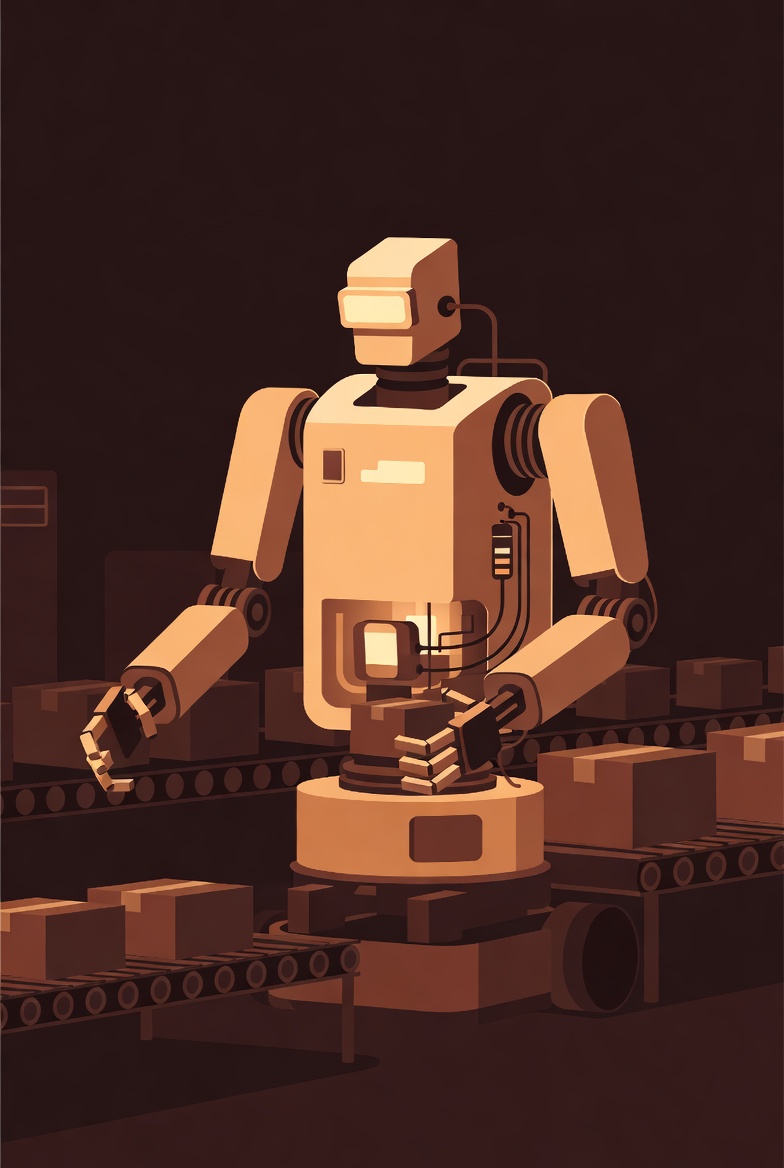
The robot itself is built for reach, not spectacle. A humanoid upper body sits on a wheeled base — stability and reliability over human-like locomotion. Dual 7-DOF arms on an articulated torso give it vertical reach from floor level to nearly two metres. At launch it covers 19 tasks across five categories: Restaurant Assistant, Packer, Picker, Folder, and Host. The brain that runs them is Physical Intelligence’s π0.7, a model that reads a natural-language instruction, looks at the scene in front of it, and figures out what the arms need to do — one model spanning packing, picking, and folding, adapting as the layout changes.
The deployment model is where Robot.com earns points for candour. Initial rollouts run at roughly 70% autonomy. Some tasks need 50 hours of teleoperation data before the robot works independently. That is not a weakness dressed up as a feature — it is an honest account of where physical AI actually is in 2026, from a company confident enough to say it out loud. One live deployment is already running at Harbor Links Golf Course in New York, handling food packing and order support.
The labour market case is stark. Quick-service restaurants lose staff at over 130% annual turnover. The average warehouse picker stays 1.2 years. More than two thirds of hotel operators are struggling to fill housekeeping and laundry roles. These are not jobs people are racing to keep. They are jobs that do not stay filled long enough to be worth training for. Robot.com is not selling R-noid as a glimpse of the future. It is selling it as a solution to a problem that already has a cost line in this quarter’s P&L.
Whether the eight-to-twelve-week promise holds at scale is the question nobody can answer yet. The CEO’s line — “no other humanoid platform can make that claim and back it up with paying customers” — is either the most important sentence in the press release or the one that ages worst. The golf course is a lighthouse deployment. A food manufacturing facility is next. The gap between those two environments is where the real test happens.
R-noid is not trying to be Atlas. It is trying to be useful by September.