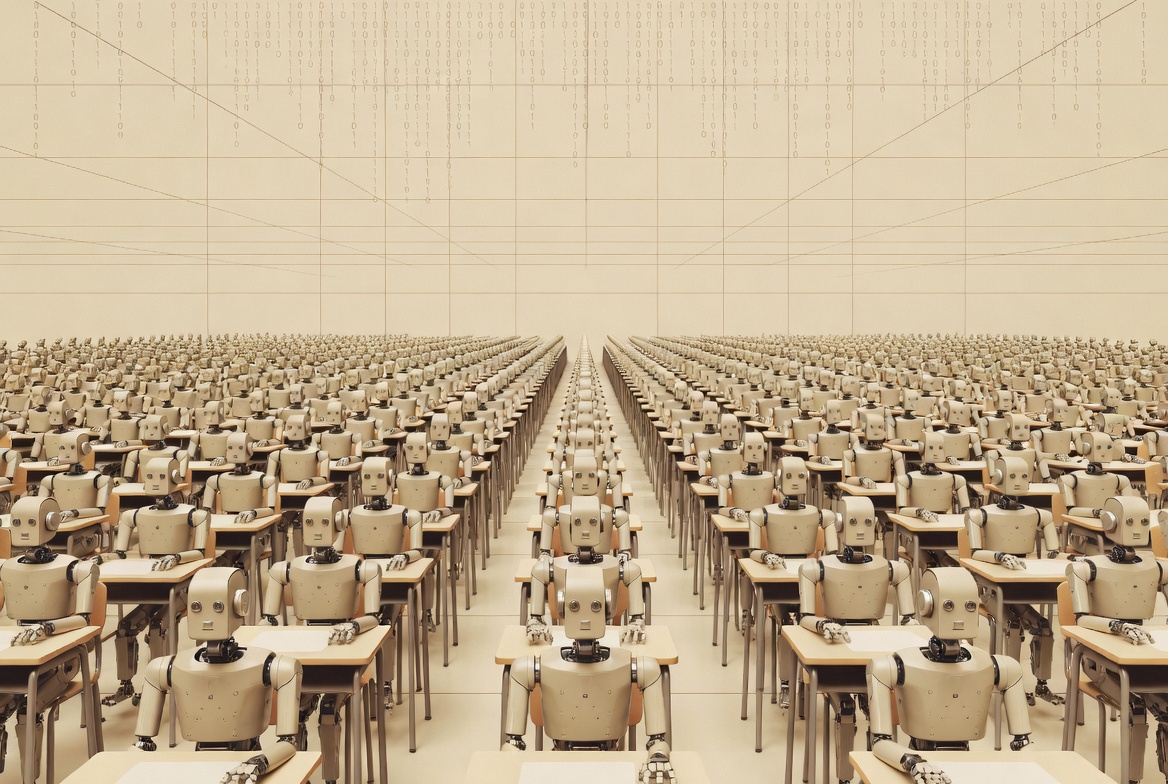
There is a step that happens before deployment. Before the warehouse, before the welding fixture, before the safety certification and the regulatory submission and the insurance premium. It happens in a server room, on a GPU cluster, inside a simulated environment that looks like the real world but isn’t.
This is where the robot goes to school.
NVIDIA’s Isaac platform is, on its surface, a practical solution to a genuine problem. Training a physical robot is expensive, slow, and dangerous. A robot learning to pick up objects will drop them. It will collide with things. It will, in the early stages, fail constantly and in ways that are difficult to predict. Running that process on physical hardware, at the scale needed to produce a capable robot, would cost more than most programmes can absorb and injure more people than any deployment would justify.
Simulation solves this. Inside Isaac Sim, a robot can run thousands of training episodes simultaneously, across thousands of parallel virtual environments, failing at speed and at scale without consequence. Isaac Lab, the reinforcement learning framework that sits inside the simulation, runs the curriculum. GR00T, NVIDIA’s generalised robot foundation model, absorbs what the simulation teaches and carries it forward — a transferable intelligence that robot manufacturers fine-tune for their specific hardware rather than building from scratch.
The result is a robot that arrives at the physical world already educated. What it knows, how it moves, what it treats as normal and what it flags as anomalous — all of it was shaped inside an environment NVIDIA designed, on rules NVIDIA wrote, in a physics model NVIDIA chose to make accurate or chose to simplify.
This is not a criticism. The alternative — a robot that learns exclusively from physical experience — is not viable at current scale, and probably not safe. Simulation is the only practical path to a robot that can operate usefully in the world within a development cycle that makes commercial sense. NVIDIA built the best simulation. The industry adopted it. That sequence is logical.
What it produces, though, is structural dependency of an unusual kind. When a company like Agility or Unitree trains its robots in Isaac, it is not just using a tool. It is accepting a curriculum. The sim-to-real gap — the stubborn difference between what a robot learns in simulation and what it can actually do in a kitchen it has never seen — is partly a physics problem. But it is also, in a meaningful sense, a syllabus problem. The simulation cannot teach what it does not model. What it does not model, the robot does not know.
NVIDIA’s answer to the sim-to-real gap is more NVIDIA. Better physics. Higher fidelity. GR00T trained on broader data. Halos monitoring the result in the real world. The stack closes around the robot at every layer — training, inference, safety, compute — and each layer that closes makes the others harder to replace.
None of this makes Isaac bad engineering. It is, by most accounts, excellent engineering. The robotics programmes that have adopted it have moved faster than those that haven’t, and the robots that have come out of it have performed better than robots trained by other means. The case for the platform is real.
The question is what the platform is, underneath the engineering. A robot that learned everything it knows inside NVIDIA’s world is not just a capable machine. It is a machine whose education, whose instincts, whose definition of normal were all set by the same company that sells the chips it runs on, the safety OS it answers to, and the simulation it was born in.
That is not a neutral position in the supply chain. It is the supply chain.