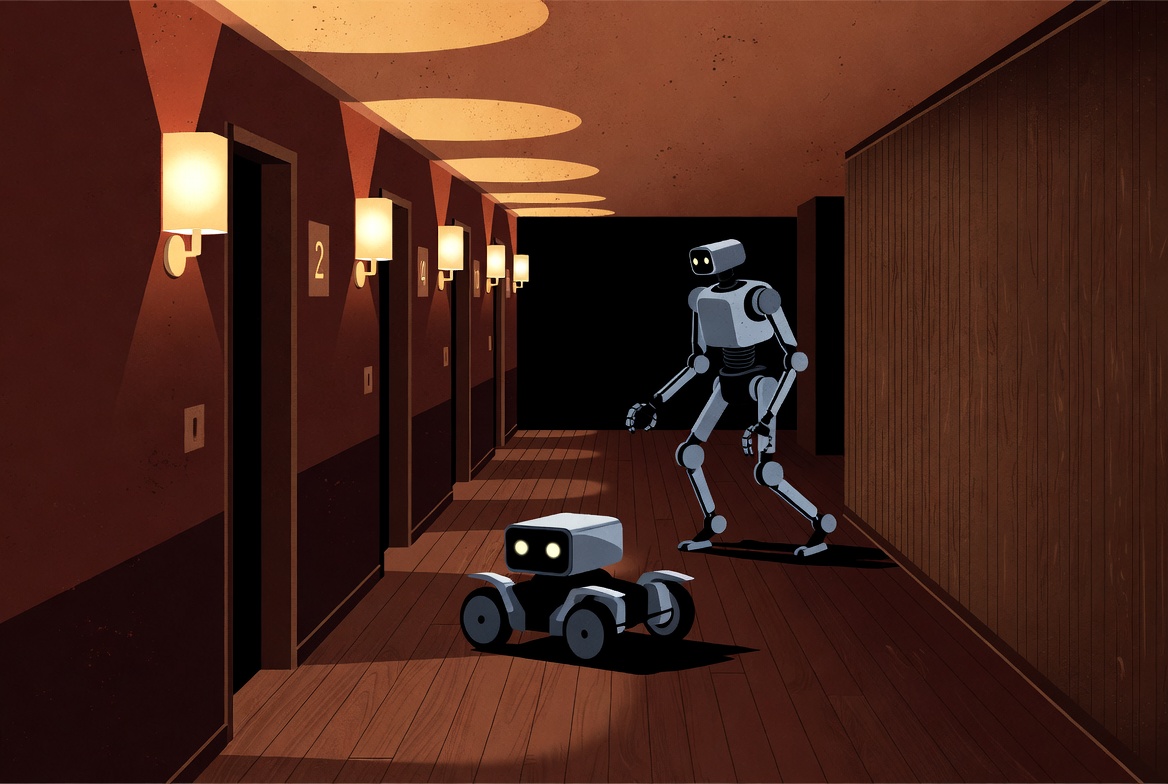
Somewhere on an artificial island in the Pearl River Delta, a hotel is being built where no human will check you in, bring you a towel, or mop the floor. Pudu Robotics and Shenzhen’s culture and tourism authority announced this month that the property on West Artificial Island — the man-made landmass at the centre of the Shenzhen-Zhongshan Link megaproject — will open to trial guests by the end of 2026, with full operations in 2027. Every hospitality role, from reception to room service to cleaning, will be filled by a robot.
That alone would be a novelty story. What makes it worth examining is the architecture underneath it.
Most hotels that deploy robots do so the obvious way: one machine for one task, each running its own software. A delivery bot that navigates corridors. A cleaning unit that vacuums. A reception screen that processes check-ins. They share a building; they don’t share a brain. The result is a patchwork of isolated automation, coordinated by humans who fill the gaps the machines can’t see.
Pudu’s model is different. The hotel will run on PuduFM 1.0, the company’s embodied intelligence foundation model, alongside a platform called PuduAgent. The architecture — built on Vision-Language-Action models and what Pudu calls world-model-driven navigation — is designed so that robots with entirely different physical forms and functions draw on the same underlying intelligence. Reception robots reading gestures. Delivery robots optimising routes. Cleaning units adapting to shifting environments. All of them, according to Pudu, running from a shared cognitive layer.
The phrase they use is “One Brain, Multiple Embodiments.” It is, as company slogans go, unusually honest about what’s being attempted.
The practical claim is significant. If a foundation model can transfer knowledge across robot categories — so that what a cleaning robot learns about a corridor benefits the delivery robot navigating the same space — it would compress development timelines and reduce the operational overhead of running a mixed fleet. Whether it actually does that at the scale of a live hotel is what the trial period is for.
The hotel itself is modest: 44 rooms, a restaurant, a gym. It sits on an island that only opened in December 2025, connected to the mainland by a bridge-and-tunnel crossing that counts as one of China’s more ambitious recent infrastructure projects. That isolation is worth noting. The island has controlled access, predictable guest flows, a floor plan that doesn’t change. It is, by design, one of the more forgiving environments in which to run a fully autonomous robot workforce.
That is not a criticism. Somewhere has to go first, and a controlled environment is a rational place to start. But it does set the frame for what this trial can and cannot tell you. A hotel on a curated island, serving guests who have opted in to the experiment, running a limited room count with a phased rollout — this is not the stress test. This is the proof of concept.
The question that follows the proof of concept is the one nobody in the press release raises: what is the failure mode? In a mixed human-robot hotel, a robot that malfunctions hands off to a person. In a single-vendor, single-model, fully automated property, a failure in PuduFM 1.0 is not a gap in coverage. It is a simultaneous failure of every function the hotel performs.
Pudu has more than 1,000 robots deployed globally across food-and-beverage and retail environments. The operational track record exists. What doesn’t yet exist is evidence that the shared-intelligence model holds under the full complexity of a hospitality environment — guests who behave unpredictably, requests that fall outside the training distribution, the ordinary chaos of 44 rooms running at capacity.
China builds these things faster than anyone else and is less squeamish about letting the public participate in the experiment. By the end of this year, there will be real guests on that island, encountering whatever the robots can and cannot do. That data will be more informative than any press release.
The hotel is designed to run without human staff. It is also, by any reasonable reading, designed to find out what happens when it tries.