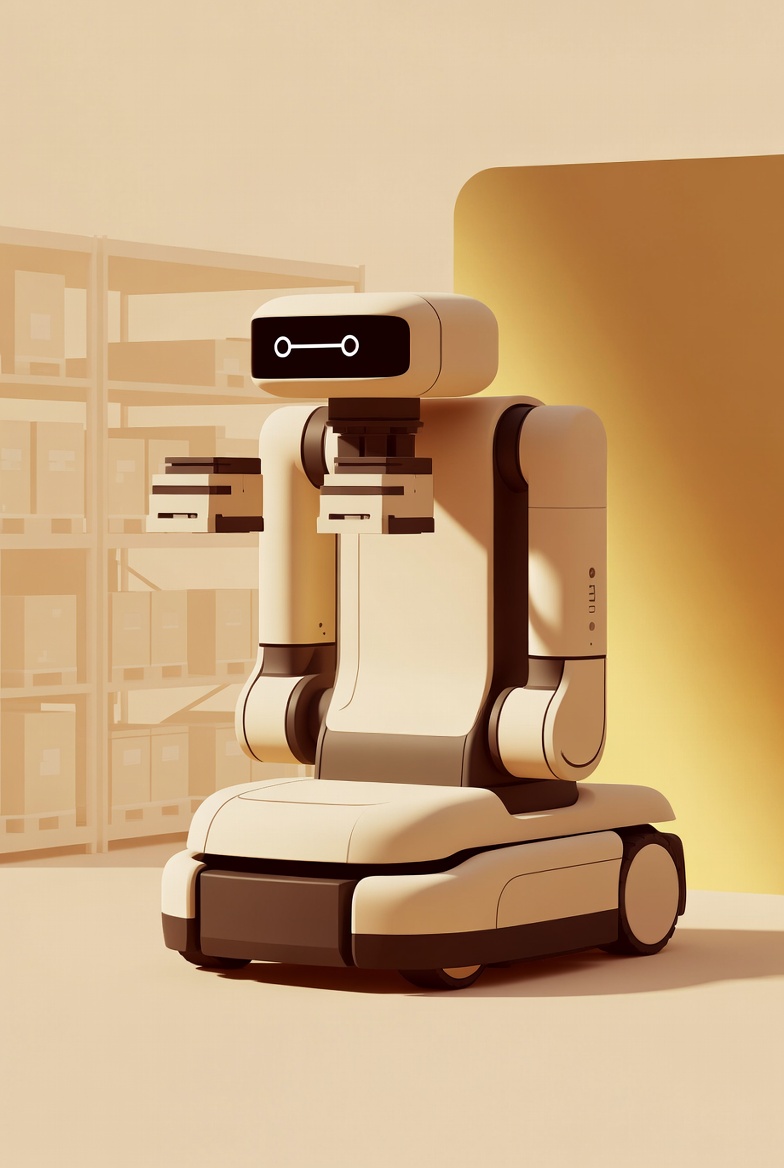
Rémi Cadène spent three years inside Tesla’s Autopilot group, writing the first neural networks for Optimus, before moving to Hugging Face to run LeRobot — the open-source toolkit that’s since become standard infrastructure in robot-learning labs worldwide. This week he unveiled UMA, a Paris-based startup with $40 million in seed funding from Greycroft and Factorial, and a humanoid called Northstar.
The pitch has two halves. One is a mobile industrial robot with dual arms, aimed at warehouses and assembly lines. The other is a smaller, human-oriented version pitched at hospitals, labs and homes — the part that gets “humanoid” into the headline. Both are built around a target weight of roughly 40 kilograms (88lb), deliberately light so the machine can work near people without the safety engineering that heavier platforms like Optimus or Figure’s machines require. The business model is robot-as-a-service: customers pay monthly for access to a fleet, not for the hardware. Cadène says UMA is already talking to around 50 potential customers, with logistics, manufacturing and healthcare pilots planned through 2026.
Here’s the detail that matters more than the funding round: the proof-of-concept UMA has actually committed to shipping by the end of 2026 runs on wheels, not legs. The legged humanoid is the long-term story. The thing that will exist this year is a wheeled base with arms.
That makes UMA at least the second company covered here this year — after Genesis AI’s Eno in June — whose founders raised money on humanoid framing while quietly building the wheeled version first, because wheels solve balance, cost and reliability problems that legs haven’t solved yet. It’s a pattern worth naming plainly: “humanoid” is increasingly the fundraising word, and “wheels” is increasingly the engineering answer, and the gap between the two is where most of these launch announcements live.
Two truths. Cadène’s résumé is the real asset here — an Optimus alumnus and a LeRobot founder is a genuinely strong technical bet, and $40 million in seed says investors agree. But the machine UMA can actually put in a warehouse by December has no legs, which is the same admission Genesis AI made in June and Foxconn made at VivaTech before that. Read the render, then read the delivery date — they’re describing two different robots.