UBTech Robotics launched its UWORLD U1 series on 30 June. On the same day, it established an artificial intelligence and robotics technology ethics committee. Four days later, the China Humanoid Robotics Committee of 100 and the China Machinery Industry Federation jointly issued an initiative urging the sector to practise “technology for good” and to build safety and ethical norms into product design, R&D, advertising and application. UBTech announced that it fully endorsed the initiative, and appointed Yan Jianguo, a National People’s Congress deputy and legal expert, as chief expert of its legal advisory committee.
The sequence is worth pausing on. The ethics committee was constituted the day the product went on sale. The industry initiative arrived after the orders.
What was actually announced
UBTech says cumulative orders for the U1 Series surpassed 13,361 units as of the launch event. The company’s total full-size humanoid sales, across the whole history of the company, stand at roughly 1,100 units. Founder Zhou Jian is targeting 30,000 to 50,000 orders. Pricing starts at 119,800 yuan — about $16,500 — for the semi-torso U1 Lite, and runs to 990,000 yuan for the U1 Ultra. First shipments are planned for mid-September.
The machine has 88 degrees of freedom, silicone skin, real hair, and an emotion-recognition system UBTech says identifies more than twenty emotional states with over 90% accuracy. That figure has no independent verification. Battery life is two to four hours, which UBTech accurately describes as the industry norm for mass-production full-size humanoids. It is also, on the company’s own numbers, less time than a working afternoon.
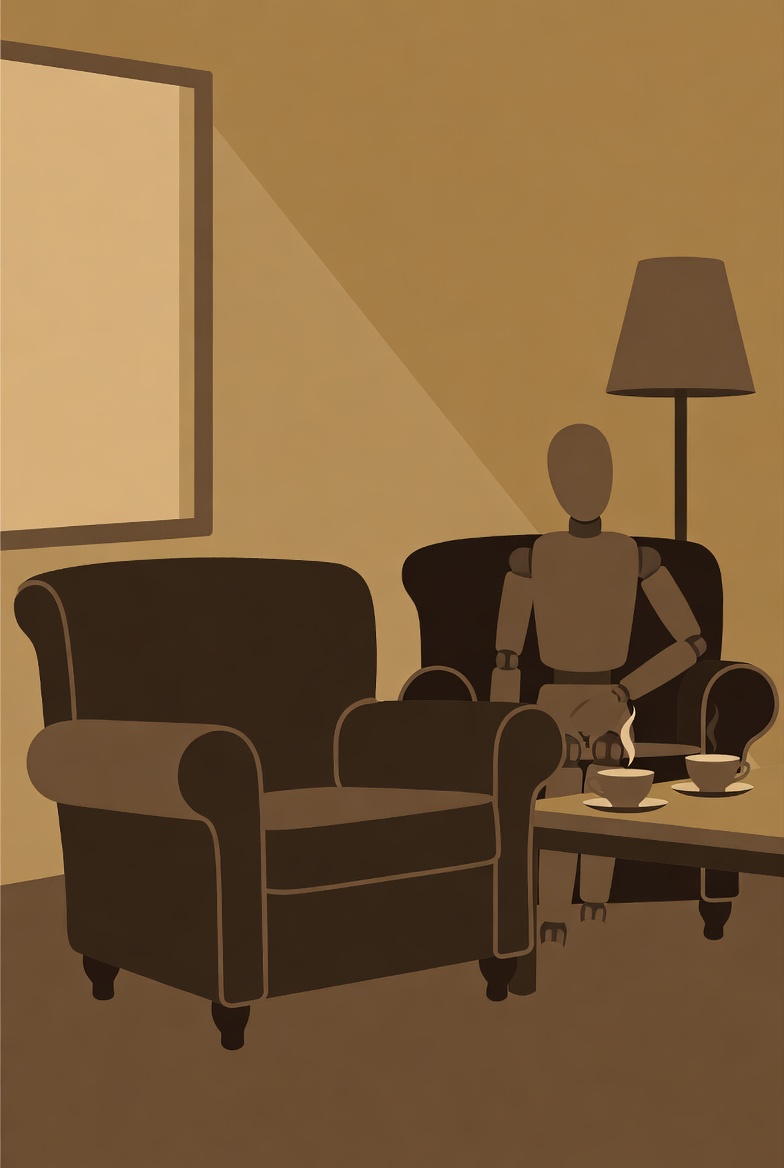
Alongside the product, UBTech announced a Human-Robot Companionship Initiative: one hundred customised U1 units to be donated in 2026 to vulnerable groups — children growing up apart from one or both parents, older adults living alone, families facing difficult circumstances. The company’s own description of the machines is that they will incorporate 3D facial reconstruction and voiceprint-based identity replication to recreate designated individuals, paired with emotion-driven interaction models and dedicated long-term memory systems.
UBTech has not said who the designated individuals will be. Its stated beneficiaries are people separated from someone living. The technology it has described does not distinguish between the absent and the dead, and the company has not been asked to.
The denial as specification
Asked about ethical concerns, UBTech positioned the U1 as an emotional companionship device — a direction, it noted, recognised and encouraged by national policy — and stated explicitly that its robots are “not boyfriends, girlfriends or partners.”
No company denies a claim nobody has made. The disavowal is a map of the demand. Zhou has said the consumer-companion market includes romance-simulation gaming. The order book tells the same story from the other end: a company that sold roughly 1,100 full-size humanoids in a decade of trying has booked more than ten times that number in a week, for a machine that cannot load a dishwasher.
It cannot, and this is not a criticism of the engineering. Pan Helin of the Ministry of Industry and Information Technology’s expert committee has described companion robots and functional robots as parallel tracks: a machine built for emotional companionship cannot perform physical labour, and a machine capable of labour lacks the emotional intelligence. The U1 is not an underperforming worker. It is a fully performing something else.
What the committee is for
Read the two announcements together and the shape becomes clear. The ethics framework is not upstream of the product; it is downstream of the order book. The initiative asks the industry to embed ethical norms into design, R&D, advertising and application. UBTech has agreed, and says it will develop an enterprise-level ethics governance model that can serve as a reference for the whole sector.
It may. But the questions raised by voiceprint replication of a designated individual — consent from the person being reconstructed, consent from the family, the psychological trajectory of a user in a room with a machine wearing a face they know — are not questions a committee formed on launch day has had time to answer. UBTech has not published its answers. It has published the existence of the committee.
Meanwhile the market has been unambiguous. UBTech’s shares rose nearly 8% on launch day, fell over 9% on 2 July, rose 17.6% on 3 July, and fell 10.01% by the close on 6 July. Investors cannot decide whether this is the company’s second growth engine or its last stand against Unitree and AgiBot, both of which outsell it in the functional segment.
Two things are true. UBTech is being more candid than its competitors: it has stated plainly what the U1 is for, disclosed the battery limits, and stood up an ethics apparatus most of the sector has not bothered with. And it has taken 13,361 orders for a machine that its own regulator says cannot perform a single household task, on the strength of a capability nobody has independently verified, for a use it is at pains to deny.
The empty chair sells better than the working one. That is not a discovery about robots.