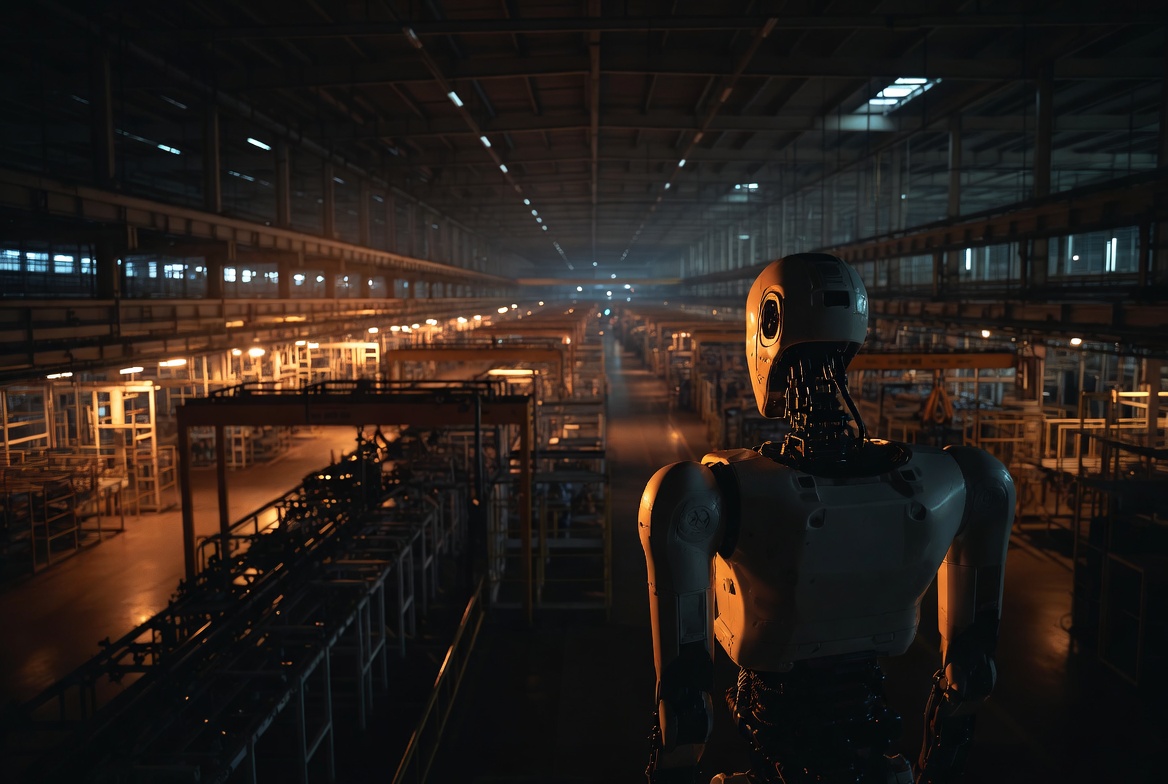
Wei Zhang has a PhD from Purdue, a tenured professorship at Southern University of Science and Technology in Shenzhen, a postdoc from Berkeley, and a former tenured chair at Ohio State. His company, LimX Dynamics, closed a pre-IPO round this week of nearly $200 million at a valuation of 15 billion yuan — about $2.21 billion. It is four and a half years old.
Asked why the hurry to list, Zhang didn’t hedge. Listing is a must, he told reporters, reaching for the comparison that he thinks explains it: Nio, Xpeng, Li Auto — the Chinese EV startups that listed in the US between 2018 and 2020, years ahead of profitability, on the strength of a bet that demand would arrive.
He is right that it rhymes. The question is what LimX has decided to sell, and to whom.
The factory is the one place the maths works
Zhang has explained why LimX did not choose factories as its primary use case. Humanoids, he argues, are not efficiency-oriented tools. They are designed to serve households and commercial settings. The company’s stated philosophy is “serve people, not process.”
Read that again with a calculator in hand.
The factory is the only environment in humanoid robotics where the return on investment can be computed by someone who isn’t selling one. A production line has a known throughput, a known labour cost per shift, a known error rate. Put a machine in it and the machine either beats those numbers or it doesn’t. That is why Figure went to BMW, why Agility went to warehouses, why Apptronik built a training facility on a factory floor. Not because factories are glamorous — because factories keep score.
Households don’t keep score. Commercial performance settings — LimX’s Luna is a 160cm, 27-degree-of-freedom humanoid the company describes as the only commercially available female-like full-size humanoid on the market, built for commercial performance applications — keep even less. A robot that dances at a product launch has no measurable displacement value. It has a booking fee.
LimX has thousands of orders, more than half from overseas. That figure has been in every write-up of this round. What no write-up contains is a repeat-order rate, a utilisation figure, or a single named customer describing what the robot did after delivery and whether they’d buy another.
The humanoid robot valuation vs revenue gap has a queue behind it
LimX is not an outlier here. It’s a symptom with company.
China has well over 100 humanoid firms riding the national “embodied AI” push. Sector investment hit 47.09 billion yuan — $6.95 billion — in Q2 alone: more than double Q1, and over six times the same quarter last year, per Xiniu. Unitree is fast-tracked for Shanghai. EngineAI has filed in Hong Kong. DeepRobot and Leju are queuing. Hong Kong is processing applications from more than 500 companies across all sectors.
36Kr, covering this round, put the mechanism plainly: most companies in the sector have not achieved profitability, and capital no longer wants to miss another “ChatGPT moment.” That is not an argument about robots. It’s an argument about fear of missing out, and it prices accordingly.
Zhang’s own framing is more precise than most: he places the industry at “the 3 to 3.5 stage” of the ChatGPT trajectory, and argues robotics cannot copy the LLM playbook of building general capability first and finding uses later. It has to deploy into real scenarios, run reinforcement learning there, and build a data flywheel. In February he told 36Kr he didn’t think 2026 would be a winter — that proof-of-concept validations would land across segmented scenarios, and scale would follow by 2027.
That is a coherent technical thesis. It is also, stated plainly, a promise that the evidence arrives next year.
What the prospectus will have to say
This is where the confidential review phase gets interesting. LimX is preparing to list, likely in Hong Kong, and a prospectus is not a press release. It requires disclosed revenue, customer concentration, repeat-order rates, and a segment breakdown. “Thousands of orders, over half overseas” is a marketing sentence. Its audited equivalent has line items.
If the household-and-commercial thesis is real, the filing will show it: recurring customers, a services line, deliveries that don’t come back. If it isn’t, the filing will show that too — in the shape of one-off sales to distributors, research labs, and event bookings, which is what “thousands of orders, more than half overseas” looks like when a robot is a novelty rather than a tool.
There’s a clock on it, too. Washington keeps adding Chinese robotics names to its military-companies list, and a firm shipping humanoids into allied markets at volume is exactly the profile that draws attention. A Hong Kong listing doesn’t insulate against that.
What to watch
Not the valuation. The filing. Specifically: the repeat-order rate, and whether any named commercial customer appears with a second purchase attached.
Two truths.
LimX has built real hardware and taken real money from investors who are not naive — IDG Capital, Lens Technology, Abu Dhabi’s Stone Venture leading, with Italy’s GGG, Germany’s Redstone VC, Nio Capital and WestSummit alongside, and JD.com and Alibaba already on the cap table from earlier rounds. Zhang’s technical argument — deploy first, learn in the real world, build the flywheel — is more honest than the industry’s usual demo-and-hope. The robots exist. You can buy one.
And: the company has ruled out the only deployment where anyone could check the numbers, raised $400 million in six months on the strength of a thesis whose proof is scheduled for next year, and is racing to a listing while the window is open. Both true at once. The market is pricing the hardware. The filing will price the flywheel.