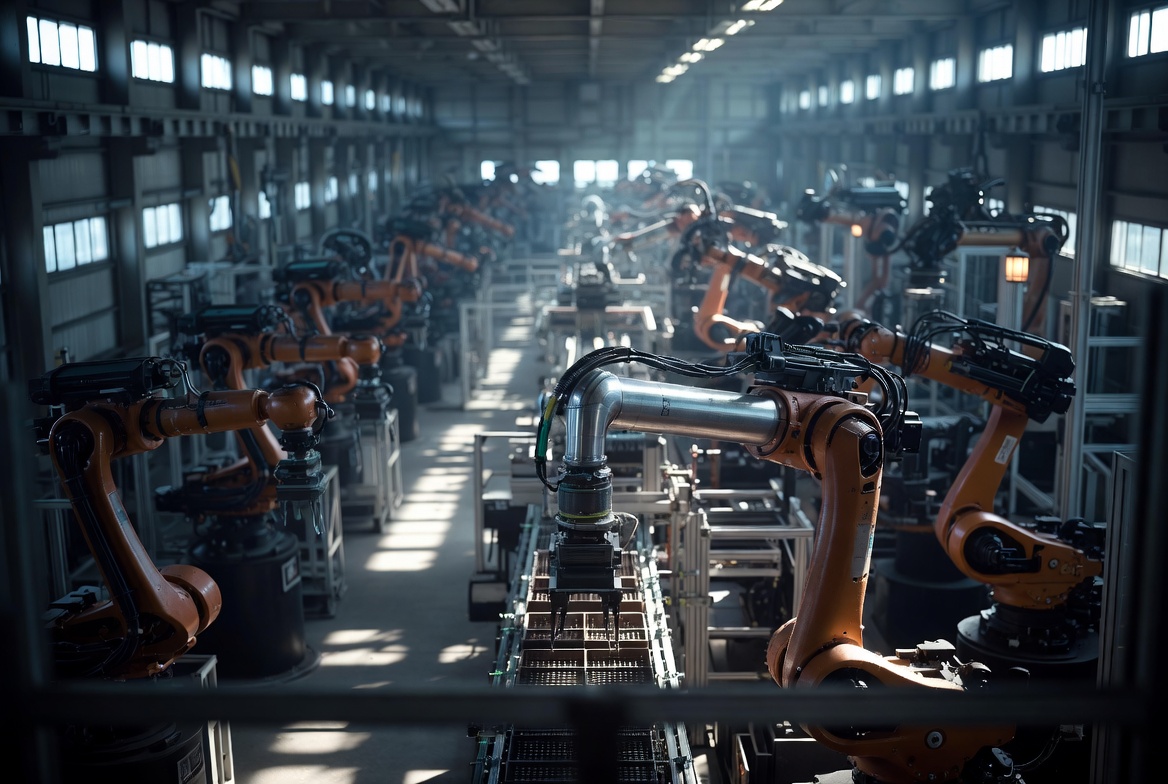
On 30 June, Japan’s Minister of Economy, Trade and Industry, Ryosei Akazawa, announced a revised national AI robotics strategy: approximately 10 million robots deployed by 2040, across 18 fields, with restaurants, food manufacturing and medical care added to the existing priorities. Two weeks later the story was still circulating, and by then it had grown an army. The Spanish outlet AS ran it as “the second country to approve an ‘army’ of 10 million humanoid robots to take on China,” illustrated with a stock rendering of chrome mannequins in ranks. Tom’s Guide called them humanoids too. Neither the strategy nor the minister did.
That is the first thing worth knowing about Japan’s 10 million robots: almost none of them are humanoid. But it isn’t the most interesting thing. If you want to know whether Japan’s 10 million robots by 2040 will actually happen, the number to look at isn’t ten million. It’s two.
The trillion yen that isn’t a trillion yen
The funding attached to the strategy is up to ¥1 trillion — roughly $6.1 billion — over five years, running from fiscal 2026 to 2030. METI and NEDO have formally commissioned a consortium called Noetra, alongside the national research institute AIST, to build a multimodal “physical AI” foundation model: a system that reads language, images, video and sensor data together, so a machine can interpret a room rather than just a prompt. Noetra is majority-owned by SoftBank, NEC, Sony Group and Honda. Fujitsu and Rakuten are reportedly still deciding. Nikkei reports the investor list could reach 44 companies.
An initial ¥387.3 billion is allocated for FY2026. And then the structure does something that almost every retelling left out.
Only the first two years are locked in. After that, funding is reviewed annually through a stage-gate process. The trillion-yen figure is a ceiling, not a commitment — Tokyo can reduce or stop the money at any annual review if Noetra misses its milestones.
This is not a footnote. It is the actual shape of the policy. A stage-gated commitment is a government saying: we will pay for the next two years, and we will decide about the rest later, on evidence. That is a good way to fund a speculative industrial programme. It is also the precise opposite of what a robot army implies. The headline number is what Japan will have spent if everything works. The reported number is what Japan has agreed to spend before it finds out.
What “10 million robots” actually contains
The 18 fields are the tell. Food and beverage manufacturing. Restaurants. Medical care. Disaster response. Manufacturing. Elderly care — where Japan already has decades of deployed hardware.
Ten million units spread across that list is overwhelmingly industrial arms, automated guided vehicles, inspection units, food-processing machinery, and care-assist devices that look nothing like a person. Japan already runs roughly 400,000 industrial robots. Its manufacturers hold something near 70% of the global industrial robotics market by METI’s own figures. This is a country expanding a category it already dominates, in the sectors where it already dominates it.
The scale is still enormous — roughly 700,000 new units a year for fourteen years, against a global professional service robot market that shipped about 180,000 units in 2024. That is a genuinely hard number to hit. But it’s hard in the way that building a lot of machinery is hard, not in the way that building a robot army is hard. Nobody at METI stood up and promised androids.
The humanoid framing was added downstream, by outlets that needed a picture. And the picture they used was AI-generated.
The thing the number is actually about
Strip out the army and what remains is a demographics story wearing a robotics costume.
About 30% of Japan’s population is 65 or older, the highest share on earth. The Recruit Works Institute has estimated a shortfall of more than 11 million workers by 2040 against 2022 levels. Immigration has not closed it and is not going to: foreign residents are roughly 3% of the population, one of the lowest shares in the OECD, and the Specified Skilled Workers expansion in 2019 produced about 2.3 million foreign workers by 2024 — real growth, and nowhere near 11 million.
So the state is buying machines instead. Akazawa’s framing was explicit: Japan’s winning strategy would be the utilisation of accumulated data. Not conquest. Inventory.
And the “take on China” line has a straightforward problem: South Korea announced a comparable national robotics push the day before Japan’s. Nobody framed that as a war either, because it isn’t one. Three countries facing similar labour maths reached similar conclusions in the same week. That’s convergence, not a race.
What to watch
The 2040 target is unfalsifiable for fourteen years, which is what makes it safe to print. The stage gate is not.
Noetra and AIST plan to release a first foundation model this fiscal year. That is the first real checkpoint, and it arrives within months rather than decades. If the model ships and works, the investor list grows past four and the funding survives its first review. If it doesn’t, the structure gives Tokyo every reason to wind down quietly rather than defend a stalled national project — and the 10 million figure will still be circulating in headlines long after the money stops.
Watch the FY2026 model release. Watch whether Fujitsu and Rakuten sign. Watch the first annual review. Those are the events that determine whether any of this is real. The 2040 number determines nothing.
Two truths
Japan’s automation push is serious, well-founded and backed by the most credible industrial robotics base in the world, because the country’s labour arithmetic leaves it no alternative worth the name.
And the number that travelled around the planet — ten million robots, one trillion yen, an army to take on China — is a ceiling attached to a review that Tokyo has already given itself permission to fail.