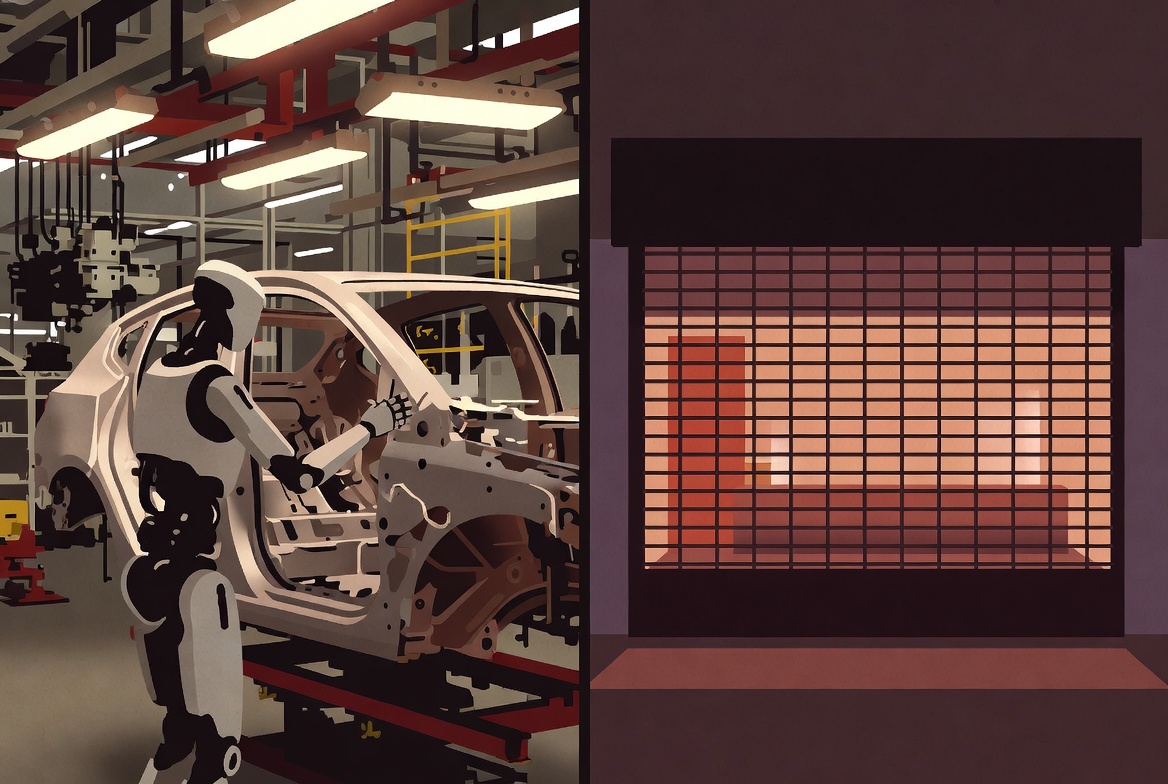
UBTech Robotics filed two very different years inside one set of accounts. Its humanoid segment brought in 820.6 million yuan in 2025 — up 2,203.7% on the year before, and now 41.1% of group revenue. It has delivered 1,079 full-size units and is sitting on a backlog worth nearly 1.4 billion yuan. This week it signed a memorandum of understanding with South Korean auto-parts maker AJIN Industrial and Duksan JM Robotics to build what would be the country’s first production line run entirely on humanoid labour, pairing the wheeled Cruzr Y1 with the bipedal Walker S2. The Walker S2 is already working a shift at a Tier-1 automotive supplier under ordinary factory conditions, not a demo floor. Production capacity is scaling toward 10,000 units a year with Siemens as a manufacturing partner, and the client list — BYD, Geely, FAW-Volkswagen — reads like a roll call of the companies that actually decide whether a robot earns its keep.
That is one truth, and by the standard this publication applies to deployment claims, it clears the bar: real clients, real order backlog, a robot doing a shift rather than a keynote.
Then the other business showed up
The other truth showed up on the balance sheet at the same time. On 30 June, UBTech launched its companion robot, the U1, and took in roughly 13,000 pre-orders worth about $305 million — a consumer bet sitting well outside the industrial business that is actually working. Two weeks later, China’s “Interim Measures for Anthropomorphic Interactive AI Services” took effect, banning addictive design patterns in emotional-AI products, mandating risk warnings and an opt-out right, and barring minors from anything styled as a virtual relative or romantic partner. Rivals felt it immediately: Doubao and Tongyi Qianwen pulled their customisable AI agents the same day, Tencent Yuanbao had already done so in late June, and Shanghai’s regulator removed more than 14,000 non-compliant AI agents from the web. The U1 also lacks the 3C safety certification Chinese consumer electronics normally carry, and its battery runs two to four hours — modest for a product whose final payments were due within days of the rule taking effect.
The reporting attributes a HK$20 billion (roughly $2.56 billion) fall in market value to this regulatory shock. Worth being precise about what that figure can and can’t tell you: UBTech’s shares are down 34.65% year-to-date and 44% from their January high, a decline that was well under way before 15 July. The share price did not need a new regulation to be falling; the regulation is a plausible accelerant layered onto a stock already sliding, not a single clean before-and-after. The distinction matters, because “a real rule hit a real product line” is a more defensible claim than “a rule erased $2.56 billion that would otherwise still be there” — and the source here supports the first, not cleanly the second.
What that leaves is a company whose industrial arm is doing the thing this publication is usually sceptical anyone is really doing — placing humanoids on production lines that would otherwise use conventional automation or people, on contracts that survive contact with a factory floor — while its consumer arm launched directly into a regulatory environment built to slow down exactly the kind of emotional-AI product it was selling. Group revenue grew 53.3% to 2.001 billion yuan; the net loss narrowed by about a third. Analysts are pencilling in profitability for 2027. None of that is proof the consumer side survives the rule change intact, and none of it is proof the industrial side doesn’t. They are, for now, simply two different bets, wearing one ticker.
The industrial arm is earning its numbers on a factory floor in South Korea. The consumer arm is learning what it costs to sell warmth in a jurisdiction that just wrote a law about it. Both of those are true, and neither one is the other’s alibi.