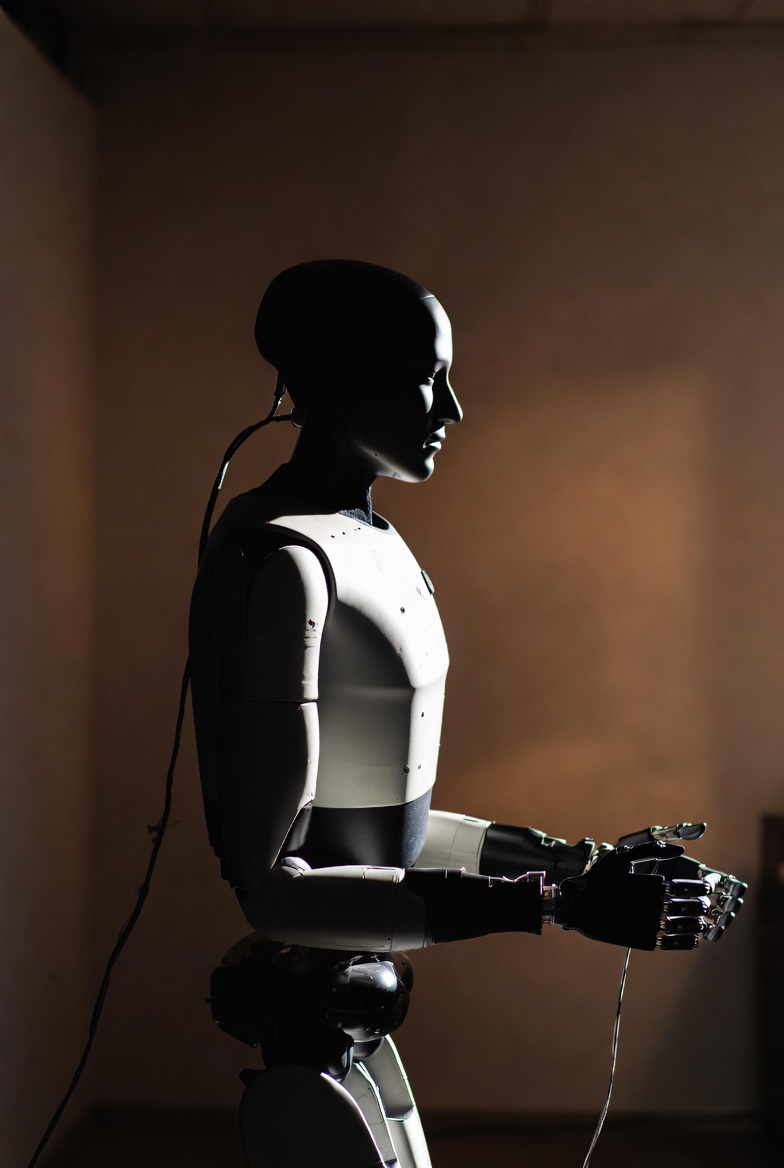
Every company launching a humanoid robot now reaches for the same word to describe systems that behave nothing alike. A robot moving through a warehouse under constant remote correction gets called autonomous. So does one making its own decisions inside a room it has never entered. What does autonomous actually mean for a robot, in practice, when the label covers both a supervised puppet and something running entirely on its own judgement? The gap between those two things is where a lot of the industry’s most-shared footage quietly lives.
Teleoperation vs autonomy: the sliding scale nobody discloses
Teleoperation vs autonomy isn’t a binary — it’s a scale, and almost nobody says where their system sits on it. Some systems are fully remote-controlled, the operator edited out of frame. Others are scripted: a fixed sequence of motions, triggered by a person, replayed convincingly enough to read as independent. A smaller group runs autonomously but with someone on call, ready to intervene the moment something goes wrong. Fewer still have no human anywhere in the loop. All four get called “autonomous” in a press release, and the footage alone rarely tells you which one you were watching.
This isn’t hypothetical. This pillar has already covered a rental model marketed under an “assistance” label that, on closer inspection, bundled a human chaperone with every unit shipped — the chaperone doing the job the marketing implied the robot was doing alone. It has also covered a multi-day continuous run genuinely worth taking seriously, precisely because the company was specific about what stayed supervised and what didn’t. The difference between those two stories was never the robot. It was disclosure.
Why the industry benefits from the blur
Nobody in this space is rewarded for precision here. “Autonomous” sells better than “scripted,” “remote-operated” undercuts a valuation story, and video compresses all four points on the scale into the same few seconds of smooth motion. A demo edited to remove the human-in-the-loop and a demo that genuinely has none look identical on a phone screen. The only way to tell them apart is to ask what happens off camera — and that is the question a press release is built to make you forget to ask.
A working definition, from here on
This is the standard this pillar now holds every capability claim to: state where on the scale a system sits — teleoperated, scripted, supervised-autonomous, or unsupervised — or the claim gets treated as undisclosed, which is scored the same as the worst case. Silence isn’t neutral. A company that won’t say whether a human was watching has, functionally, told you one was.
Two truths. The robots genuinely are getting better — the supervised-autonomous tier is real, and it is improving fast enough to notice month over month. And most of what gets called “autonomous” in a headline is still a person, somewhere off frame, quietly doing the hard part.