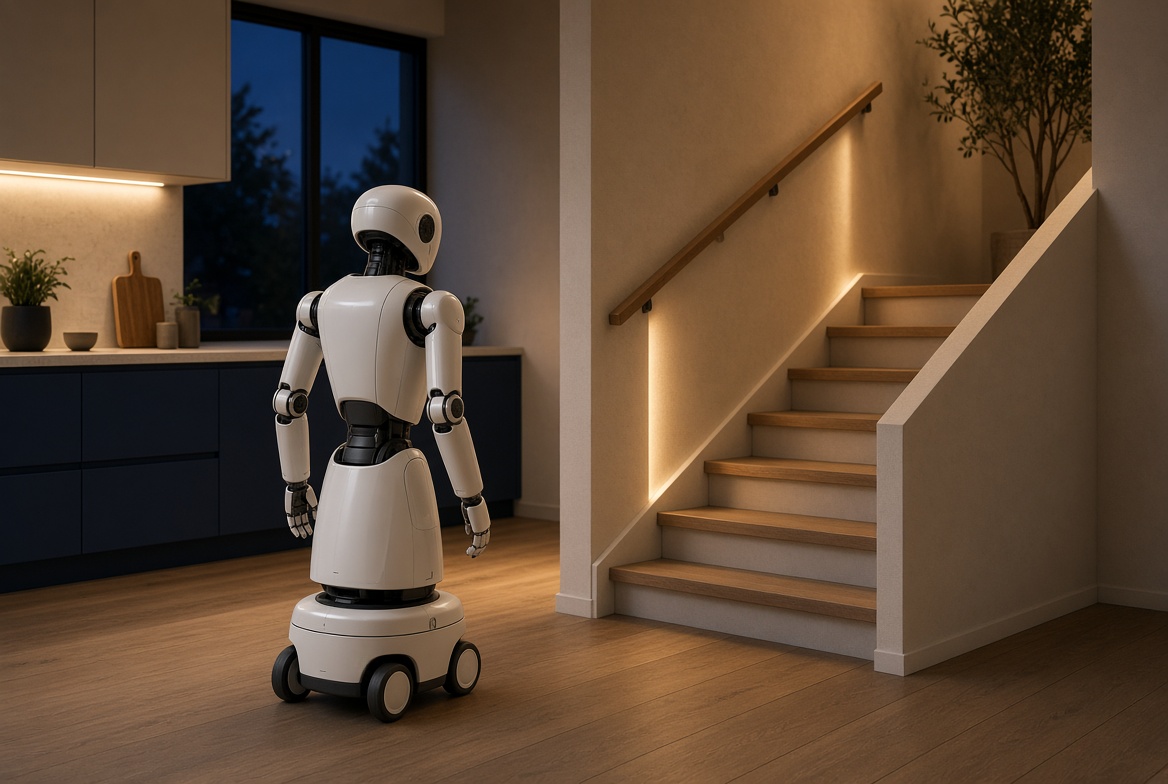
At IFA 2026 in Berlin this week, LG’s CLOiD stood at the exhibition entrance as a “conductor,” greeting visitors and orchestrating appliances across a 16-metre LED stage — the robot’s second public outing since it debuted at CES in January, where LG framed it as the centrepiece of a “Zero Labor Home”: a single humanoid with a wheeled base, two seven-degrees-of-freedom arms and five independently actuated fingers per hand, meant to retrieve items from the fridge, load the oven, fold laundry and run the rest of the house through LG’s ThinQ ecosystem. LG says it is now training hundreds of CLOiD units at a data factory in Seoul, working toward 100,000 hours of task data by the end of the year — a serious, expensive bet that one robot, trained hard enough, can eventually do everything a house needs done.
Nobody else at IFA is betting the same way. Sharing the floor with CLOiD were Amazon’s Astro, Ecovacs’ LilMilo, SwitchBot’s Kata, Intuition Robotics’ ElliQ and Doova — a wheeled, armless companion robot for elderly users built around expressive facial animation rather than manipulation — plus a cluster of Chinese humanoids booked for IFA’s “Robots on the Runway” showcase on 5 September. None of them attempt what CLOiD is attempting. Each does one narrow thing: vacuum, keep an ageing user company, control the lights, fold a specific category of laundry. Even 1X’s Neo, the closest thing to a rival general-purpose home humanoid at $20,000, still ships into real houses with a remote human operator on standby rather than running unsupervised — the same teleoperation safety net this site has flagged in industrial settings before, here wearing a different company’s logo.
The reason isn’t a failure of ambition. It’s the staircase. CLOiD’s base is wheeled, which means the version LG is showing off — the one meant to run an entire “Zero Labor Home” — cannot leave the ground floor of a house that has more than one. A general-purpose home robot that cannot reach the laundry room if it’s upstairs is not general-purpose; it’s a capable single-storey appliance with an unusually good marketing story. Real homes are staircases, narrow hallways, pets, toddlers’ toys left on the floor and furniture that moves — the unpredictable, unstructured mess that warehouse and factory floors are deliberately engineered not to have. It’s the same gap this site has tracked in commercial deployments all year, just relocated from the loading dock to the living room.
Two truths from one trade-show floor: LG’s data-factory bet on CLOiD is a real, well-funded attempt at the hardest version of the home-robot problem, and 100,000 training hours by year’s end is not nothing. But every robot actually earning its keep in an actual home right now does one job, not all of them — and the fastest way to notice the gap between the demo and the delivery is to ask a general-purpose humanoid to climb a single flight of stairs.