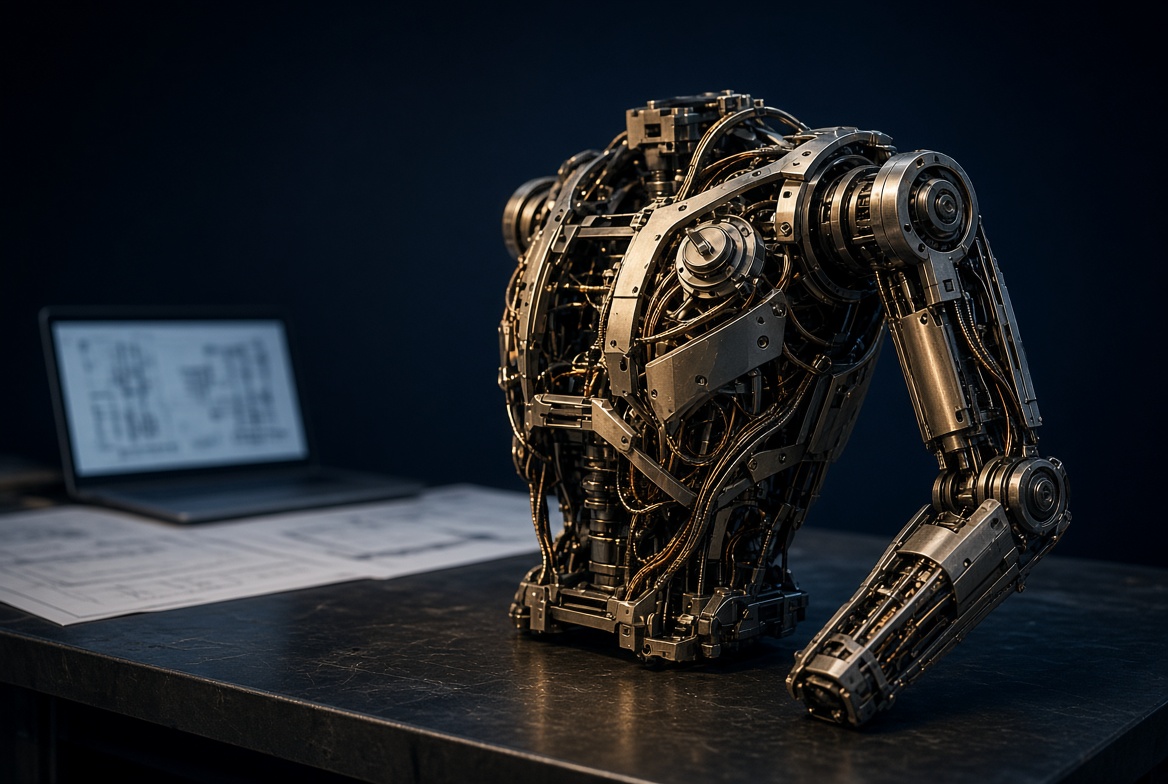
Sam Altman confirmed, on the record, that OpenAI is building a humanoid robot. Asked on the podcast Sources whether the company’s robotics push meant data-centre machines or human-shaped ones, he didn’t equivocate: “Both. We will definitely do a humanoid. We will do other form factors as well.” He went further, saying he thinks “everyone should have a personal robot” — the kind of line that, coming from the CEO of the world’s most valuable AI company, moves headlines regardless of what’s behind it.
What’s behind it, for now, is a careers page. OpenAI has nineteen open robotics roles in San Francisco, four of them specifically for actuator, electromagnetic and gear design — the unglamorous mechanical engineering that turns a research paper into a limb that can lift something without snapping. The listings point toward end-to-end, in-house actuator development rather than licensing a design from an established supplier, which is either a serious long-term bet on vertical integration or the fastest way to relearn every lesson Boston Dynamics, Agility and Unitree have already paid for. No manufacturing partner has been named. No prototype has been shown. Altman gave TIME a firm date for the company’s other hardware project, the Jony Ive-designed tabletop device — early 2027 — and gave the humanoid nothing firmer than “definitely.”
That gap is the whole story. Every company this publication has covered in the humanoid space earns its coverage by doing something concrete: Figure has robots on a BMW line, UBTech has a backlog worth 1.4 billion yuan, Unitree has an IPO and a Shanghai listing to defend. OpenAI has language-model dominance, tens of billions in compute commitments, and — as of this week — a stated intention. Intention is not nothing; a company with OpenAI’s balance sheet and hiring reach can move from job posting to working prototype faster than a startup can, and its foundation models are exactly the kind of general-purpose brain the industry has spent two years arguing humanoid hardware still lacks. But intention is also not a robot, and the distance between “we will definitely do a humanoid” and a machine that can fold laundry without a remote operator watching has swallowed better-funded promises than a nineteen-line job board.
Two truths, and they’re not in tension: OpenAI is serious enough about humanoids to start hiring the mechanical engineers who build them, and OpenAI currently has exactly as much hardware to show for it as anyone else who has only posted job listings. The confirmation is real. So is the fact that it confirms nothing about when, or whether, this ends anywhere near a living room.