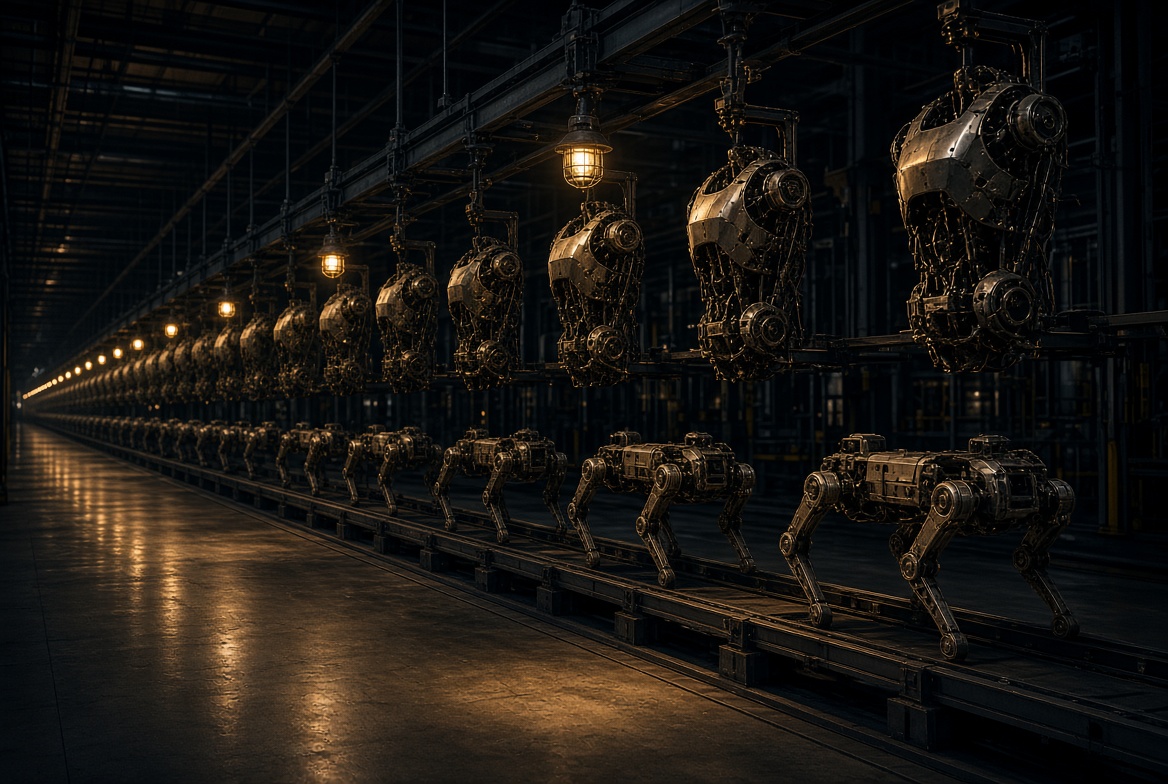
On 29 August 2026, in the western Serbian city of Šabac, a Chinese auto-parts manufacturer and a Shanghai robotics company opened what independent reporting is calling Europe’s first mass-production facility for humanoid robots. Minth Group and AGIBOT put €20 million into phase one, targeting more than 5,000 units a year; the two companies have already announced a second phase, a €200 million “Robotics Industrial Park” outside Belgrade, aimed at eventual capacity of 20,000 humanoid robots and robotic dogs a year, explicitly built for “Made in Serbia” export into the EU. Serbian President Aleksandar Vučić attended the opening and placed the serial marking on the first robot alongside Minth’s founder — the kind of photo-op a government stages when it wants a factory read as an unambiguous economic win.
It arrives five weeks after the US added Chinese-made humanoid and quadruped robots to the FCC’s Covered List, barring their import and sale over unpatched security flaws — this site covered RoboStore’s very different response to the same ban. Where RoboStore chose to keep selling into a restricted market by rebuilding the sensitive last step domestically, AGIBOT’s move goes the other way: build the plant somewhere the restriction doesn’t reach, then sell “Made in Serbia” into the market that will actually take the volume. A US import ban that assumed China’s factories were the fixed point turns out to have an easy answer if the factory itself can move.
That would be the whole story if Vučić had stopped at the ribbon-cutting. He didn’t. Within the same news cycle, he promised that Serbia’s Armed Forces would put the facility’s robotic dogs on public display within two weeks — not walking, he said, but carrying “very serious weapons,” with Serbian engineers having built the software for remote weapons control. It’s a claim, not yet a demonstrated fact, and Serbian officials have a domestic audience to perform for as much as a foreign one. But it lands in a country that took 57% of its major arms imports from China between 2020 and 2024 — CH-series combat drones, FK-3 air defense, CM-400AKG missiles — with its own defense minister crediting those purchases for “significantly enhanced” capability. A civilian mass-production robot factory and a defense minister’s procurement record are not automatically the same story. Vučić chose, on his own initiative, to make them one.
The EU has already drawn the connection Belgrade might have preferred it not draw. Serbia’s accession talks have been effectively stalled since 8 July 2026, with eight member states blocking the next negotiating cluster — and the European Parliament named “deepening security and defence cooperation with China” as part of the reason, weeks before this factory broke ground. A robot that ships with cameras, microphones and remote software updates is a data-security question even when it’s welding car doors; a government demonstrating the same hardware armed, in a country whose EU application is already stuck partly over its China ties, turns that question into a foreign-policy one.
Two truths, one ribbon-cutting: the industrial achievement is real — Europe’s first humanoid mass-production line, a credible path to 20,000 units a year, an actual answer to a US import ban that assumed the factory couldn’t move. And the government that opened it chose, unprompted, to spend the same week proving why “just a robot factory” was never going to be the whole read on it.