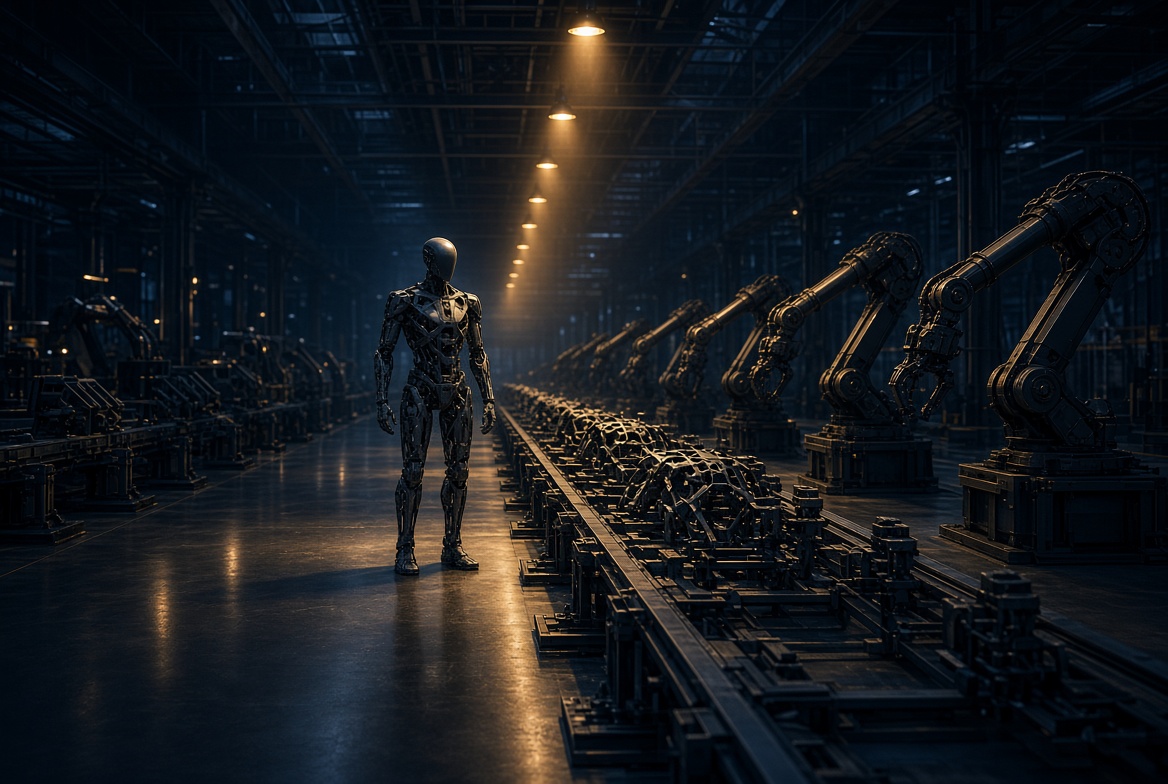
XPeng, the Chinese EV maker, commissioned a new production line for its humanoid robot IRON on 8 September 2026, and — by the company’s own account — the robot’s first act was to autonomously walk off the end of it. XPeng calls it the world’s first automated production line for advanced humanoid robots. Core process automation, the company says, exceeds 80%, built to what it describes as automotive-grade manufacturing standards. IRON itself: 76 degrees of freedom across the body, 21 in each hand, three of XPeng’s own Turing AI chips running at up to 2,250 combined TOPS, an enclosed flexible lattice frame instead of exposed servo joints. CEO He Xiaopeng’s framing: “the robot production lines were created from scratch with no precedent to follow.”
Mass production is targeted by the end of this year. Commercial deliveries, in China and overseas, are pencilled in for 2027. Both dates come from XPeng. So do the automation percentage, the chip count, the degree-of-freedom tally, and the video of a robot leaving its own factory floor under its own power — a demonstration staged and filmed by the company currently raising money on the strength of it, which is a different kind of claim than an independent inspection, even though the specs underneath it are specific enough to be checked against the hardware later rather than dismissed outright as a marketing reel.
What’s missing is the two numbers that would actually tell you whether this is a business yet: how many units the line can build, and what one costs. CnEVPost, covering the same launch, states plainly that XPeng “did not disclose production capacity or robot price.” The company’s only comment on unit economics is qualitative — gross margin on IRON will be “significantly higher” than on its EVs — which is an easy thing to say about a product nobody has bought yet, and an easy number to withhold once someone actually tries to price one.
Timing is doing some of the work here. This lands three weeks after XPeng closed a raise north of $900 million — IDG Capital, Tencent and Alibaba among the backers — pricing its robotics arm above $6.3 billion, by its own account China’s largest single-round raise for embodied AI to date. A fully automated line, if it holds up at scale, is exactly the proof point that valuation needs. It is also exactly the kind of thing worth showing off before the harder numbers — yield rate, real unit cost, an actual order book — are ready to survive anyone asking about them directly.
Most of the coverage of this story reached for the same comparison: Tesla’s Optimus, a robot this publication has already covered losing a 610,000-car assembly line’s worth of factory floor to a robot that, as of that piece, had not done a paid day’s work (Issue 046). Only one outlet checked for this piece put numbers to that comparison directly — a roughly 10,000-unit 2026 target attributed to Musk, a January 2026 admission that no Optimus units were yet doing useful work, a repeatedly delayed Optimus V3 reveal. Those specific figures didn’t corroborate independently in what was checked here, so take them as one outlet’s characterisation rather than a confirmed fact. The broader shape of the comparison — that Optimus is running behind its own announced schedule — isn’t actually in dispute; it’s this publication’s own prior reporting, not something borrowed for effect from whoever wrote the punchiest version of today’s story.
Two truths: XPeng has put out real, specific, checkable engineering claims — degree-of-freedom counts, chip TOPS, an automation percentage — that make this the most substantive humanoid-manufacturing disclosure to come out of China this year, and it has stayed deliberately silent on the two numbers, price and capacity, that would tell you whether any of it is a business yet rather than a very well-funded demo reel. Both are true. The robot walking off the line by itself is evidence of the first one. It is not evidence of the second.