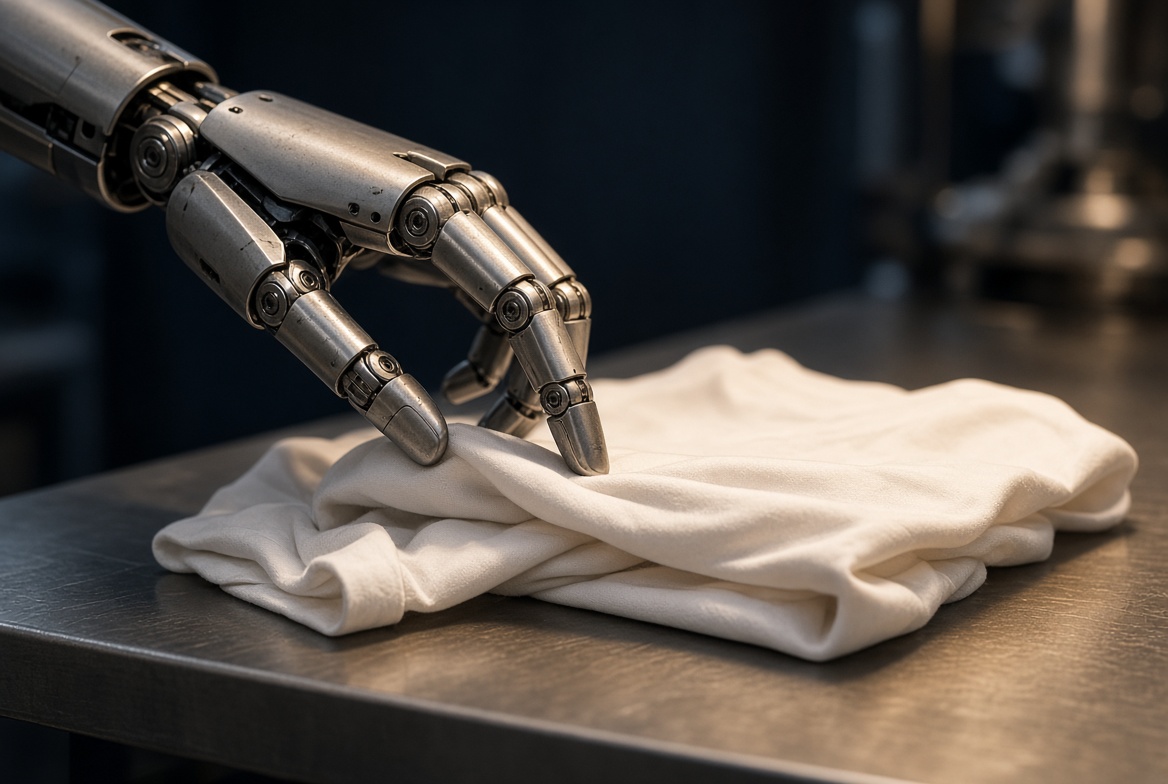
Toyota wants 400,000 robots working across 60 factories worldwide by the time the rollout finishes, starting in 2028, at a price the company itself puts at roughly ¥1 trillion — about $6.4 billion — every year. That figure isn’t all humanoids; it folds in ordinary automation and equipment Toyota was going to replace regardless. But the program’s flagship is ELEY, a 50-kilogram wheeled robot built in-house at Toyota’s Frontier Research Center, and its stated job is unusually specific for a press cycle that mostly runs on adjectives: capture what roughly 18,000 takumi — master craftspeople nearing retirement — know how to do, before they retire and take it with them.
The demo Toyota chose to show off makes the scale of that ambition look almost modest. At the company’s European headquarters this month, ELEY folded a T-shirt “near-perfectly.” It took 1,500 practice repetitions over two weeks to get there, learning by watching human workers wear finger-shaped sensor jigs and copying the motion through a technique called Diffusion Policy. One garment. Two weeks. Fifteen hundred reps. Judged in a demo room, not on a line running three shifts. If that’s what it takes to reliably fold a shirt, the gap between this demo and 400,000 machines doing unscripted craft work across 60 factories is the actual story, not the trailer for it.
Toyota’s engineering choices reflect that gap more than the marketing does. Unlike Tesla’s Optimus or Hyundai’s Atlas, both bipedal, ELEY rolls — trading the harder, more photogenic problem of walking for stability, so the company’s research effort can concentrate on hands. Its actuators use a deliberately low 10:1 gear ratio, which lets a joint yield to unexpected contact instead of fighting it: a concession to a factory floor where things go wrong in ways a scripted demo never has to survive.
What sets this apart from most humanoid coverage this publication runs isn’t the ambition — every company in this space claims a moonshot number — it’s that Toyota’s own Frontier Research Center put a named list of what doesn’t work yet next to the pitch, not buried in a footnote or dragged out under a skeptical question. Three gaps, on the record: whether performance holds up across an 8-to-12-hour shift instead of a two-week practice window; whether fingertip precision generalizes to grips it wasn’t trained on; and how to build the data infrastructure to share what one robot learns across a fleet that’s supposed to eventually number 400,000 machines at 60 sites. That last one is the quiet admission underneath the headline number — Toyota is pricing the robots before it has solved how they’ll teach each other anything.
Two truths: $6.4 billion a year and 400,000 units is a commitment few competitors can match, aimed at a real and specific problem — a retiring generation of craftspeople whose skill has no other backup. And the only fully-disclosed capability demonstration behind it is one robot, one T-shirt, fifteen hundred tries, with the company’s own scientists naming the reliability, precision and data-sharing problems they haven’t solved. Toyota is choosing to be more honest about the second truth than almost anyone else in this coverage — which is exactly why the first number deserves the scrutiny, not the applause.
Distance to Spare Key
Autonomy 1 · Novelty 1 · Objects 0 · Failure 0 · Temporal 0 · Breadth 0 → 2/30Moved by: nothing new on the instrument — this is the same low-disclosure pattern the rubric keeps finding. The T-shirt fold is real and the company names its own gaps unusually candidly for the sector, but the demo itself discloses no failure rate, no edit/real-time status, one object category trained specifically for the task shown, and a controlled European-HQ demo floor rather than an unseen environment. Autonomy gets a 1 rather than 0 because the imitation-learned policy runs without described live teleoperation during execution — but Toyota never states “no human anywhere in the loop,” so it doesn’t earn higher.