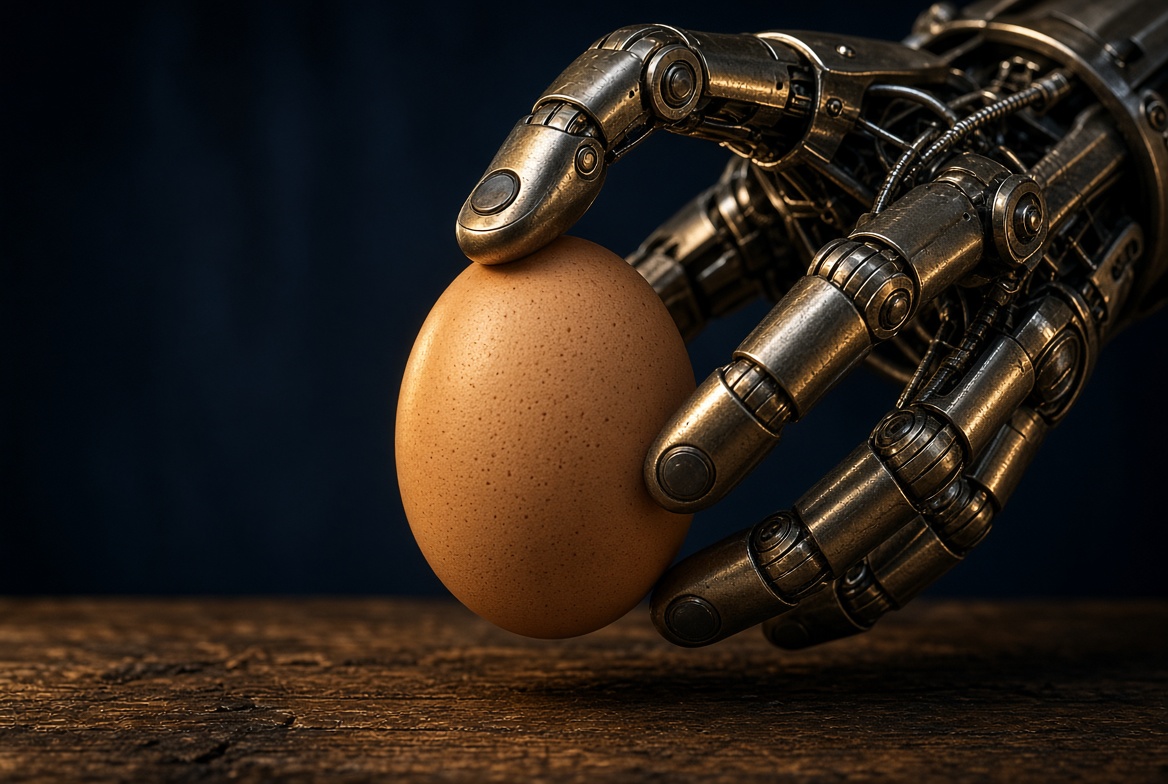
Buy a Unitree G1 humanoid and the base unit runs about $16,000. Add a pair of three-fingered hands — the part that actually does anything once the robot has walked over to do it — and the price roughly doubles. That number is worth sitting with, because it inverts what most coverage of this industry assumes: the hard part was never getting a robot to walk, or even to walk well. It’s getting it to pick something up.
Bob McGrew, formerly OpenAI’s chief research officer, put it plainly: “Manipulation is the hard problem we need to solve to make humanoid robots useful, not locomotion.” The gap between the two is not close. A human hand carries roughly 17,000 touch receptors feeding a brain that has had a lifetime to calibrate them; a research-grade robot hand carries a few dozen to a few hundred sensors, feeding a model that has had, at most, a few years. NASA’s Robonaut 2 hand, at roughly $250,000, manages a 9-kilogram payload. The Shadow Dexterous Hand — marketed, not incorrectly, as the most advanced hand commercially available — runs about $100,000 and tops out at 4 kilograms. An adult human hand grips at 40 kilograms or more, for free, with no marketing copy attached.
None of this is a story about one bad supplier. Alberto Rodriguez, who works on manipulation at Boston Dynamics, frames it as an unavoidable trade-off: a hand has to balance strength, dexterity, slenderness and ruggedness, and improving one of those axes tends to cost you another. Cramming 20-plus degrees of freedom, useful tactile sensing, and enough structural strength to survive being a robot into something the size and shape of a human hand is a different kind of hard problem than teaching a biped not to fall over. Kevin Lynch, who directs Northwestern’s robotics and biosystems center, puts a number on it: roughly ten years before dexterity like this is realistic in the kind of applications companies are already selling against.
The demo reel doesn’t carry any of this. Figure’s Figure 03 has tactile fingertips and a compliant grip. Tesla’s Optimus has folded a shirt on camera, in a motion press coverage has since described as pre-programmed and brittle rather than adaptive. 1X’s Neo struggles in practice with tasks as basic as gripping a watering can by its handle or pouring from it — a large part of why so much of what Neo actually does in a customer’s home is still a person, not the robot, doing the gripping. Sanctuary AI, Apptronik and Shadow Robot are all shipping some version of the same hybrid answer: teleoperation to cover what the hand can’t yet do on its own, sold as a bridge rather than an admission. Rodney Brooks, who co-founded iRobot and has spent decades being right about how slowly this field actually moves, predicts that deployable humanoid dexterity will still be “pathetic” next to a human’s past 2036. There is, notably, no standardized benchmark anyone in the industry has agreed to be measured against — which means every dexterity claim in this space is, for now, ungraded homework.
Two truths: over 160 companies have raised more than $7.2 billion since 2015 betting that a humanoid robot is a viable product, and the single component that decides whether it can do the job — the hand — is more expensive than the rest of the machine, weaker than a human’s, and by the clearest expert estimate available, roughly a decade from being otherwise. The bet isn’t on the robot. It’s on the hand catching up to the marketing.