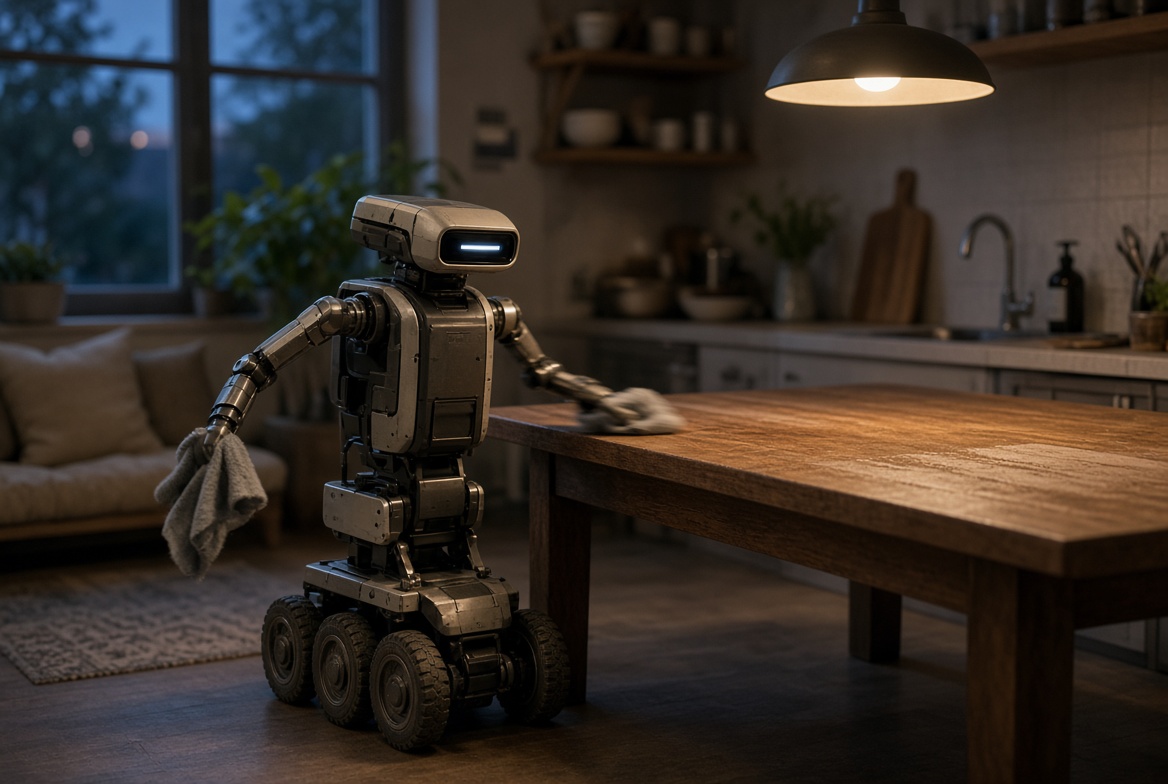
Flourish Robots, a nine-month-old startup split between San Francisco and Paris, opened pre-orders on 30 September for the Flourish 1: a six-wheeled, 110-centimetre robot with two arms, a Raspberry Pi for a brain, and a price tag of $3,555. Founder Antoine Marcel, a repeat founder backed by Families Fund, says the first 50 units — hand-built — ship before Christmas. The pitch is specific: teach it a chore by holding your phone and demonstrating the motion, no code required, about thirty minutes per task. It will pick up shoes, clothes and toys, wipe a table, water a plant, clear a litter box, and — depending which of the company’s own accounts you read — load or not load a dishwasher.
The number that matters most sits next to a rival’s. 1X’s Neo costs $20,000 and spends much of its working life being operated by a 1X employee through the robot’s own cameras — teleoperation dressed as autonomy. Marcel’s pitch draws the contrast on purpose: Flourish, he says, is “designed to operate autonomously once a task has been taught,” with no remote human standing in for the robot the way Neo’s does. Strip out that claim and you’ve stripped out the entire premium case for the $3,555 price: a cheaper robot that doesn’t need someone else’s labour hidden inside it is a genuinely different product, not just a discounted one.
Nobody outside the company has checked whether the claim survives contact with a real kitchen. The only published demonstration — a short video of a Flourish 1 wiping a table — was watched by exactly one journalist, who described the motion as “herky-jerky” and ran no test of his own; no outlet that covered the launch conducted an independent trial, and none has disclosed how the video was recorded, whether it was cut, or what the attempts that didn’t make the reel looked like. Marcel himself concedes the robot works “reliably, but still relatively slowly,” and that it “may struggle” when a home’s layout changes significantly — precisely the scenario the per-household, phone-taught training method exists to solve. A 3.3-pound payload limit rules out a full laundry basket or a stack of plates before the autonomy question is even reached.
Two truths: a robot built around a Raspberry Pi instead of an onboard GPU, priced at under a fifth of the nearest comparable product, is a real and interesting bet that household robotics doesn’t need expensive silicon to ship — the economics here are not marketing. But “no human anywhere in the loop” is the single hardest claim in this industry to verify from outside, and the evidence offered for it so far is one unscripted-looking video of a robot wiping a table, slowly. The price is confirmed. The autonomy is still Flourish’s word for it.