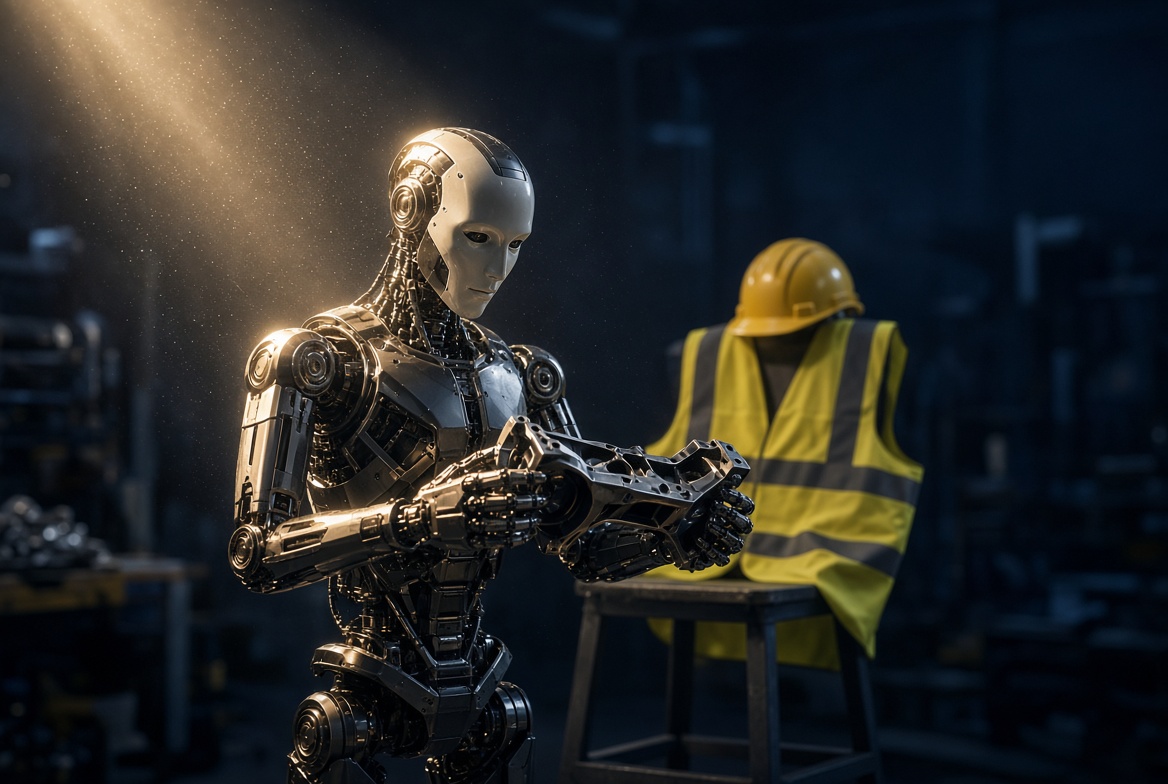
On 21 September, Boston Dynamics opened the Robotics Metaplant Application Center — RMAC, in the acronym Hyundai’s press office is already using — inside Hyundai Motor Group Metaplant America, near Savannah, Georgia. It is, in plain terms, a classroom: a dedicated facility where Atlas humanoid robots learn factory work before anyone lets them near an assembly line building actual cars. Chief Product and Technology Officer Zack Jackowski called it “physical AI at enterprise scale.” The curriculum, for now, is less grand than the phrase suggests: logistics preparation, and sequencing parts so they arrive at the right station in the right order. Component assembly is scheduled for 2030. Lifting heavy loads unsupervised is further out than that.
Two months before RMAC opened, the same plant’s timeline collided with the people whose jobs it concerns. In July, Hyundai’s unionized autoworkers at the company’s Ulsan plant staged what several outlets called the first strike in the industry over a robot — roughly 35,000 workers demanding a vote before Atlas units entered a factory floor. Hyundai finalized its takeover of Boston Dynamics that same week. No vote followed. Two months later, a school for the robot exists at a Hyundai plant, built on a timeline the strike didn’t appear to alter at all.
None of this means the deployment plan shrank. Hyundai and Kia are still committed to roughly 25,000 Atlas units across their global plants over the next few years — a number this publication has already reported once, under a more skeptical headline about where you’d actually buy one. A separate US manufacturing line is being built to produce 30,000 robots a year, the same figure Boston Dynamics gave analysts this month to justify a valuation that still assumes profitability nobody has shown yet. RMAC itself is slated to grow tenfold by 2027. What changed on 21 September isn’t the ambition. It’s that the ambition now has an address, a curriculum, and a start date — none of which existed when the workers who’ll be standing next to Atlas first asked for a vote on it.
Read the timeline end to end and the sequence is almost too clean: acquisition finalized, workers strike over consent, strike ends without a vote, training center opens two months later at a Hyundai plant, framed as “physical AI at enterprise scale” rather than as any kind of answer to what the strike was actually about. Jackowski’s other line — that Boston Dynamics wants “a future where robots amplify human potential” — reads fine in isolation. Next to the picket line that preceded it by eight weeks, it reads like a company that heard the question and answered a different one.
Two truths: Boston Dynamics genuinely built a real, physical facility to train a real robot for real automotive tasks on a real published schedule — this is not vaporware. And the workers whose plant it’s built inside asked, in July, for a vote on exactly this, and by September’s opening, nothing in the record shows they got one.