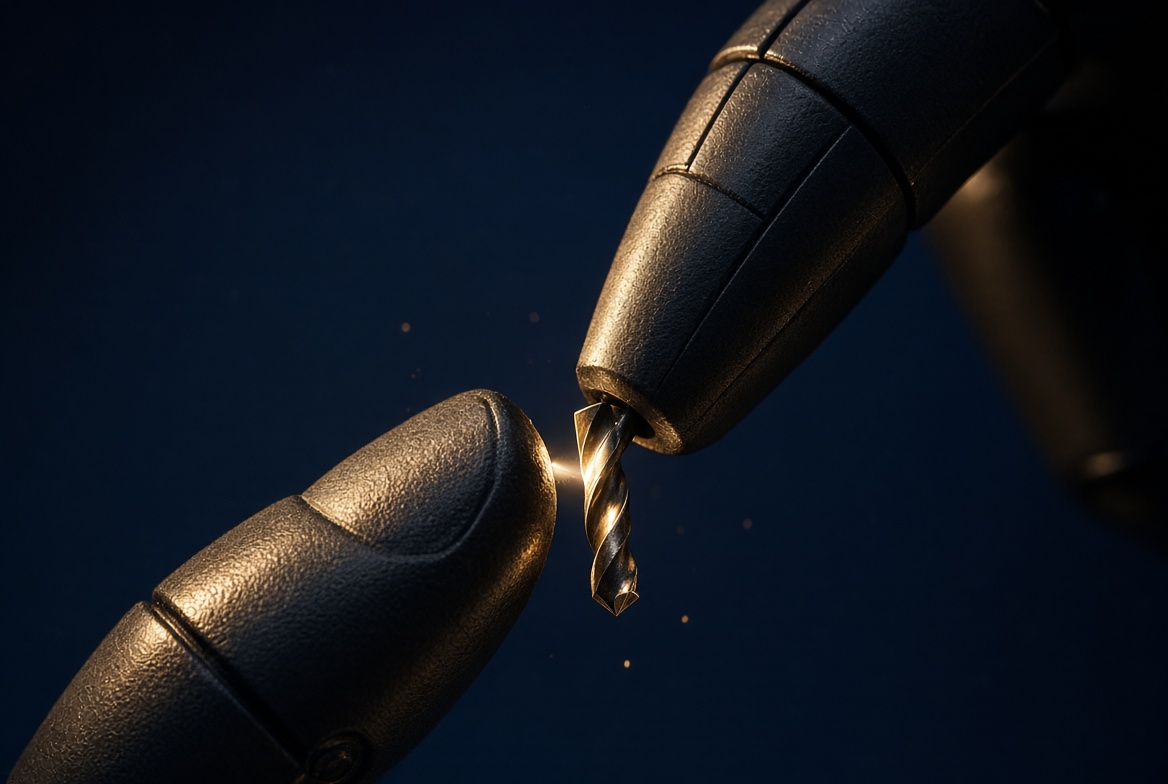
Boston Dynamics’ new hand for Atlas has four fingers, not five. The company dropped the pinky — along with the roughly three degrees of freedom, the added actuators and the extra width it would have needed — after a few engineers spent a day with their pinky and ring finger taped together and decided they didn’t miss it. What’s left is a thumb with four degrees of freedom and three fingers with three each: thirteen in total, directly actuated, with no cables running across the joints to fray or slip.
The pitch isn’t that the hand is more human. It’s that it’s more useful, specifically at the one job hands do worst on every humanoid shipped so far: holding a tool and using it like a tool, not gripping an object for a demo video. Boston Dynamics says the hand is built for drills, torque drivers, grinders, nail guns and welding torches — manipulation that depends on precise, sustained grip force rather than a photogenic five-fingered wrap around a coffee cup. It’s also sized to match a large adult hand, on the logic that the further a robot’s hand departs from human proportions, the less use it can make of the vast pile of human manipulation data everyone in this industry is trying to train on.
That data problem is the real subject here, even though the announcement is about hardware. Every humanoid company publishing dexterity claims this year is running into the same wall: dense tactile sensing and sim-to-real reinforcement learning depend on a hand whose physical behaviour is tractable enough to simulate accurately, and tractable enough that a policy trained entirely in a simulator will actually transfer when it ships. Fewer degrees of freedom isn’t a concession here. It’s a bet that a simpler, more precisely modelled hand will out-dexterity a more anatomically complete one that nobody can train reliably — the same logic, inverted, that has made more fingers and more joints mostly produce more failure modes elsewhere in the industry.
None of this means the hand problem is solved. Boston Dynamics reports “promising” sim-to-real transfer on dynamic tasks, which is the kind of adjective that means real but not finished. No date has been given for when this hand reaches a robot customers can actually order.
Two truths: cutting a finger to improve a robot hand is a genuinely interesting engineering argument, and it’s also an admission — made by the company furthest ahead on legs — that nobody has yet built a humanoid hand that does more by doing more. The industry’s hands are still its weakest link. This is what “weakest link, worked on seriously” looks like.