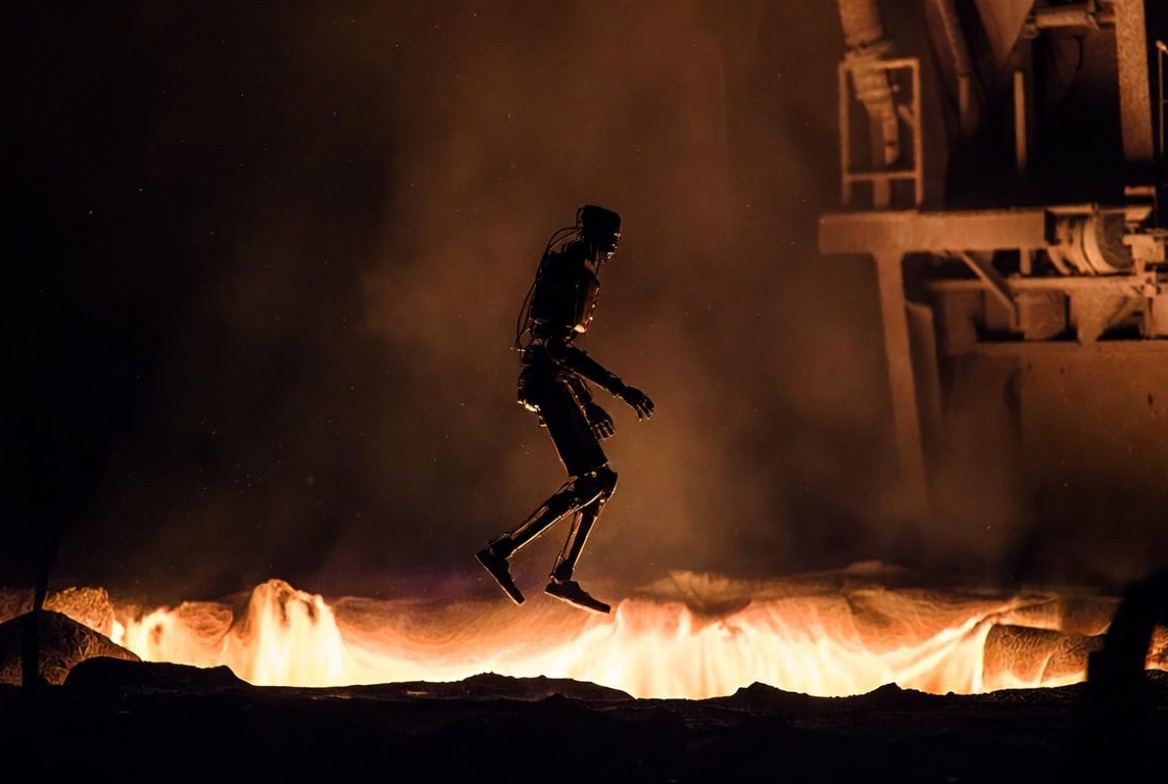
Figure’s F.02 robots spent eleven months at BMW’s Spartanburg plant, loaded more than 90,000 metal parts, and helped build over 30,000 X3s before the trial ended and the newer F.03 fleet took over. That part of the story is nearly a year old. What happened to the retired robots afterwards is new, and it’s the part that actually tells you something.
Figure didn’t sell them, donate them, or put them in a lobby display case. It sent what was left of the fleet to a steel foundry in Imatra, Finland, where a 75-ton electric arc furnace melted them down — six melts, twenty-four hours, each robot leaping in under its own power, by Figure’s account, with footage it says is real. Arnold Schwarzenegger, having told CEO Brett Adcock on social media that he should “melt them,” got a cameo: a thumbs-up traded with a disintegrating robot, echoing the scene that made the idea famous thirty-five years earlier. It is, by design, a very good clip.
It’s also, by the company’s own account, a supply-chain decision dressed as a stunt. Figure says no metal foundry it approached in the US or Mexico would let it feed a robot containing lithium-ion batteries into their furnaces — the Finnish facility was the only one that said yes. And the reason the robots needed destroying at all, rather than refurbishing, reselling or simply storing them, was that Figure didn’t want the custom actuators and other proprietary hardware inside them ending up anywhere a competitor, or a teardown video, could get at them. A handful of units are being kept at headquarters. The rest no longer exist in a form anyone could examine — apart from some of the resulting steel, which has come back to the US and is due to become a limited run of commemorative F.02 artefacts.
That’s a strikingly complete solution to a problem most of this industry hasn’t had to answer yet: what do you do with last year’s humanoid once it’s obsolete, and worth more to you destroyed than sold? Figure’s answer — route the intellectual-property anxiety through a Hollywood reference so the actual decision reads as a joke rather than a tell — is a genuinely effective piece of communications. It also means the industry’s first visible answer to “what happens when a working robot fleet gets replaced” was incineration, not resale, not refurbishment, and not much transparency about what, exactly, was inside them.
Two truths: watching a robot leap into molten steel on command, with a film star narrating, is a better demonstration of reliable autonomous locomotion than most of the capability videos this industry releases on purpose — if Figure’s account holds. And the fact that destruction was the safest option for robots that spent a year building real cars is a quieter, less flattering data point about how disposable — and how proprietary — this generation of hardware actually is.