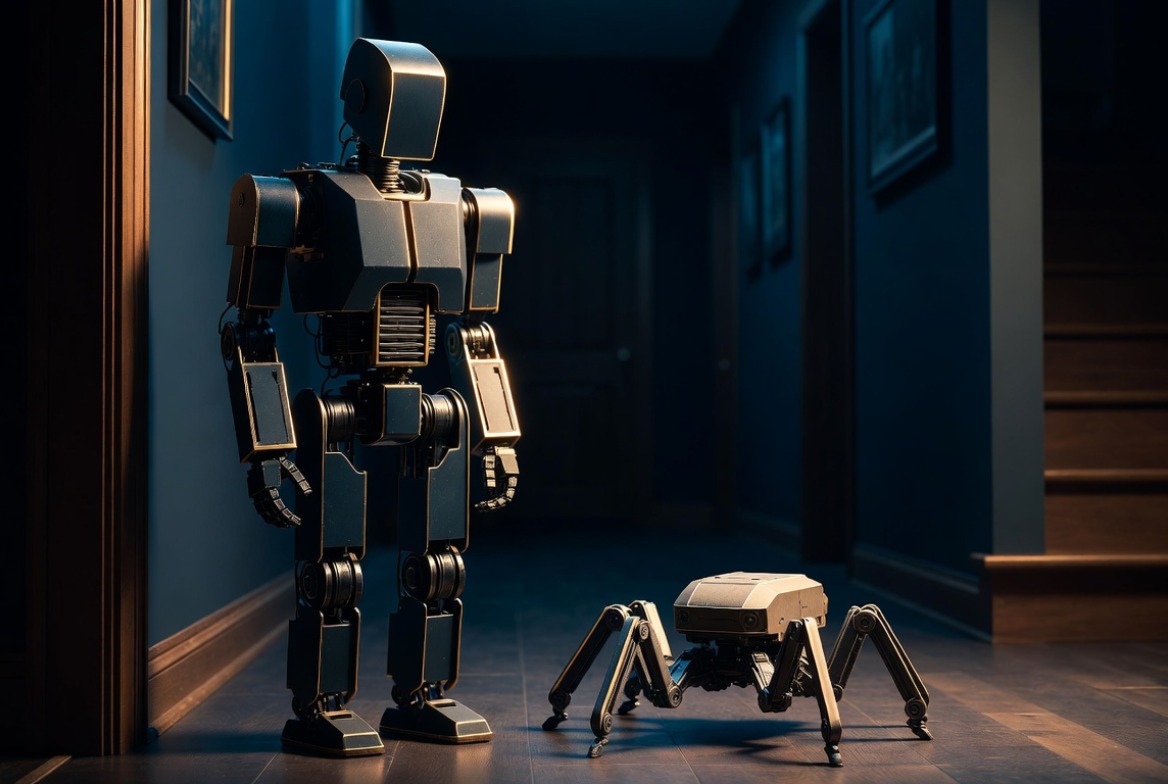
On the live-streamed tech show TBPN on 1 October, Mark Cuban restated a prediction he has made before: the humanoid robot push, he thinks, will fail within five to ten years. His reason is not that the underlying AI won’t work, but that the shape is wrong. His case isn’t that robots won’t do the work. It’s that the work should design the robot, not the other way around. “The robots aren’t going to be humanoids,” he said. “They’re going to be whatever the optimal shape is.” Homes, in his telling, get redesigned around whatever does the labour: hidden rails, purpose-built housings, “spiders or ants” rather than something built to look like a person.
His exhibit is already running at scale. Amazon operates more than a million robots across its warehouse network, and almost none of them walk, grip or look remotely human. They roll, lift and sort, built narrow for one job each, and the fulfilment network runs on them at a throughput no humanoid company is within reach of matching.
An Agility Robotics executive pushed back with the industry’s standard answer: reshoring manufacturing to the US needs “a combination of human employment and automation technology,” and a robot shaped like the worker it’s replacing can step into a job built for human hands, in a space built for human bodies, without the factory having to be rebuilt around it first. That’s a real argument. It’s the brownfield case this publication has made before for why a biped, not a wheeled base, is the one that doesn’t need the building redesigned. It isn’t, though, a rebuttal to what Cuban is actually claiming, which is about where the economics land once the retrofit era ends and purpose-built robots get their own spaces instead of borrowing ours.
Both sides are making a timing bet dressed up as a design argument. Cuban’s bet is that the retrofit era is short, and specialised machines arrive fast enough that a general-purpose humanoid never earns back its premium. The humanoid makers’ bet is that the retrofit era is long: long enough that a machine shaped like a person earns its cost simply by being the only thing that can walk into a world already built for one, no redesign required. Nobody in this argument has deployed anything at the scale needed to settle it. Amazon’s million robots prove task-specific automation works, at scale, today. They don’t prove a humanoid can’t also work. They just prove it isn’t necessary yet, for the one company that has actually run the experiment.
Two truths: Mark Cuban is very likely right that the cheapest way to automate most jobs today is still a narrow machine built for that job, not a humanoid. The humanoid bet has never really been that it’s cheaper. It’s that it’s the only shape that can walk into a job, a home or a factory floor exactly as built, while everyone else is still waiting for the retrofit.
Cuban has made this five-to-ten-year prediction before: a March 2026 Business Insider report carries the same figures. The TBPN appearance is a restatement on a fresh platform, not a new position.