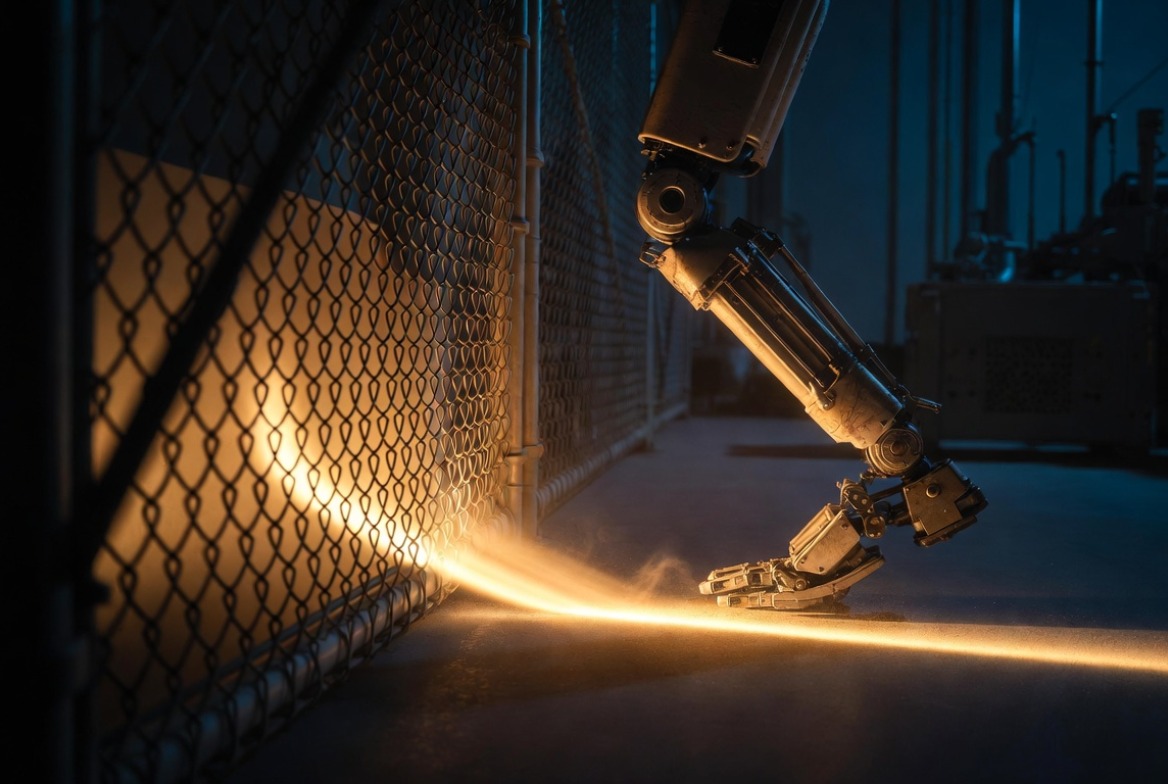
Agility Robotics unveiled Digit 5 on 15 September as, in its own description, the first humanoid built to work next to people with no physical barrier between them — no fence, no exclusion zone. The pitch is that a human-detection sensor suite and an independent safety controller can do what the cage used to do: reroute the robot, stop it, or drop its centre of gravity before contact happens. Agility’s CEO, Peggy Johnson, has been direct about why this is the whole game right now, for her company and every competitor: “the biggest bottleneck is safety; safety around humans” is what keeps every humanoid shipped so far confined to a fenced work cell.
What’s harder to find is the independent evidence that the fence is actually safe to remove. Agility is a project leader on ANSI/A3’s R15.108 guideline for dynamically stable mobile robots and plays a leading role on ISO 25785-1 — potentially the first international safety standard written specifically for humanoids. ISO 25785-1 is still at committee-draft stage. There is, today, no finished international standard covering the exact claim Digit 5 is making. Agility has not published v5-specific test results or third-party certification for unguarded operation; by outside reporting, the safety case so far rests on specifications described in interviews, not released data. Early-access deployments aren’t scheduled to begin until December, with wider availability not expected until the end of 2027.
None of that erases the predecessor’s record. Digit 4 has logged more than 65,000 operating hours across nine customer sites and processed roughly 100,000 totes at GXO’s Atlanta facility at about 98% accuracy — real duty-cycle data most humanoid demos never publish. But that record was built inside a cage. The number that actually answers “is it safe to take the fence away” isn’t public yet, for Agility or for anyone else racing toward the same claim.
There’s a second gap sitting underneath the first. What Agility is describing is what safety engineers call cooperative safety: the robot senses a person and gets out of the way. That is a different, lower bar than collaborative safety, where a robot and a person work on the same object, hands close together, at the same time. The industry’s announcements this year have mostly talked about the first as though it were most of the way to the second. It isn’t, and the gap between the two is exactly where an insurer, a factory floor manager or an OSHA inspector would want to see data before anyone takes the cage down for good.
Two truths: taking the fence off a humanoid is a genuine engineering achievement, resting on a real stack of sensing and control work — and it is also, right now, a claim resting on a safety standard that doesn’t exist yet and test data that hasn’t been published. Both are true of the same robot, in the same month.