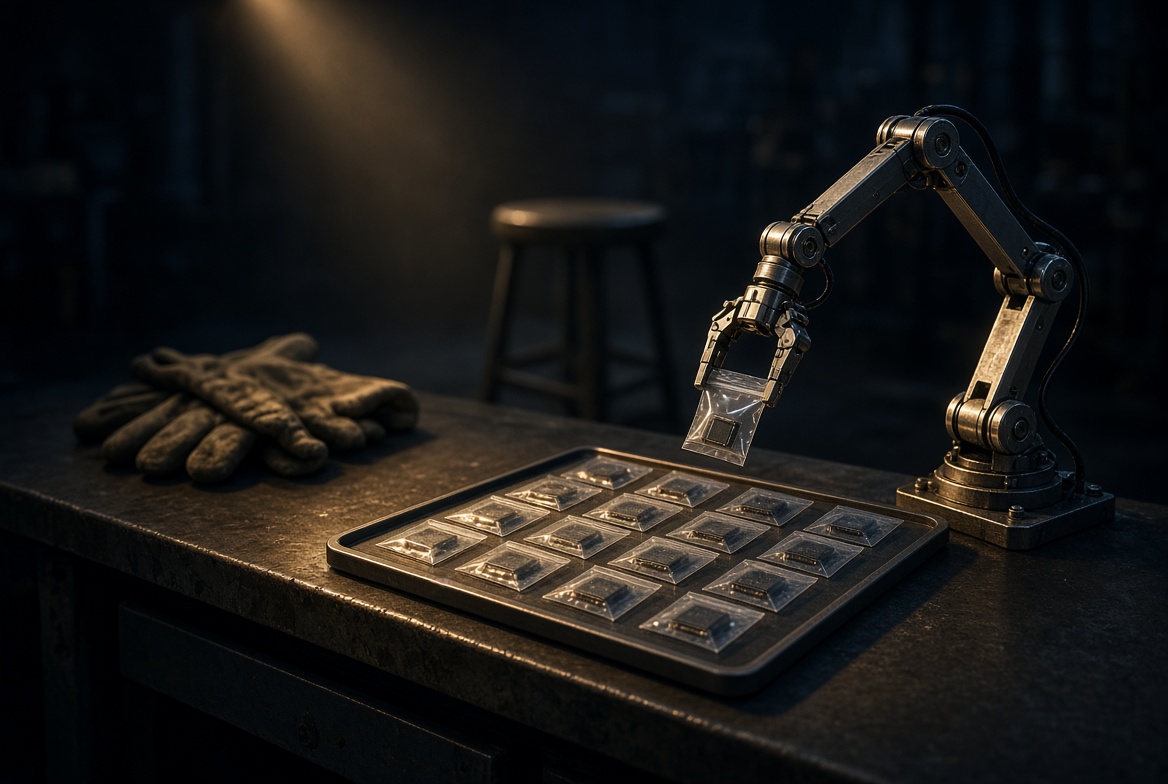
ASUS has built a humanoid robot, and its first job is putting small parts in bags into a box.
In a blog post dated 13 November, ASUS introduced Gallop, its first humanoid, now working at an ASUS group manufacturing plant packing motherboard accessories. The station involves 15 small parts, many in thin clear bags, and a board arrives about every 20 seconds. Gallop is a two-armed robot on a fixed base, run by a single NVIDIA Jetson AGX Thor computer, with a hand ASUS designs itself. ASUS says the target is 99.5% success within the 20 seconds, “the same standard” it holds a person to. Pilots with customers are planned for 2027, a wheeled version is next, and the company is aiming for market availability in the second half of 2028.
What is real. A named job, at a real plant, with a cycle time anyone can check against a stopwatch. Thin bags are a genuinely awkward thing for a robot hand, and packing is repetitive work that factories find hard to staff. ASUS is also unusually plain about what the station is: one job, fixed in place, in its own group’s plant, not a general-purpose worker. Starting somewhere dull and bounded is how most automation that sticks has started.
What is being sold. The 99.5% is a target. ASUS has published no measured success rate, no number of boards run, no uptime and no comparison with the people doing the same station. The robot is not yet in front of a single outside customer, and the 2028 date is an intention. Nor is there a price or a specification sheet. The line that the robot isn’t meant to replace workers, only the stations hardest to staff, is positioning, and it sits awkwardly beside the training method. Experienced workers wear head cameras, with their consent, so Gallop can learn how they do the job, and an operator in a VR headset then guides the robot through it. ASUS says those workers move into setting up, supervising and improving the robots. That may well be true. It also means the people filmed are producing the training data for the machine that will later do their station, and ASUS does not say whether they are paid for it or how many such supervisory roles exist.
Two truths. A robot that handles 15 floppy parts in 20 seconds would be a real piece of dexterity. Until ASUS publishes how often it gets it right, and what happens to the people who showed it how, the “upskilling” line is a promise and not a result.