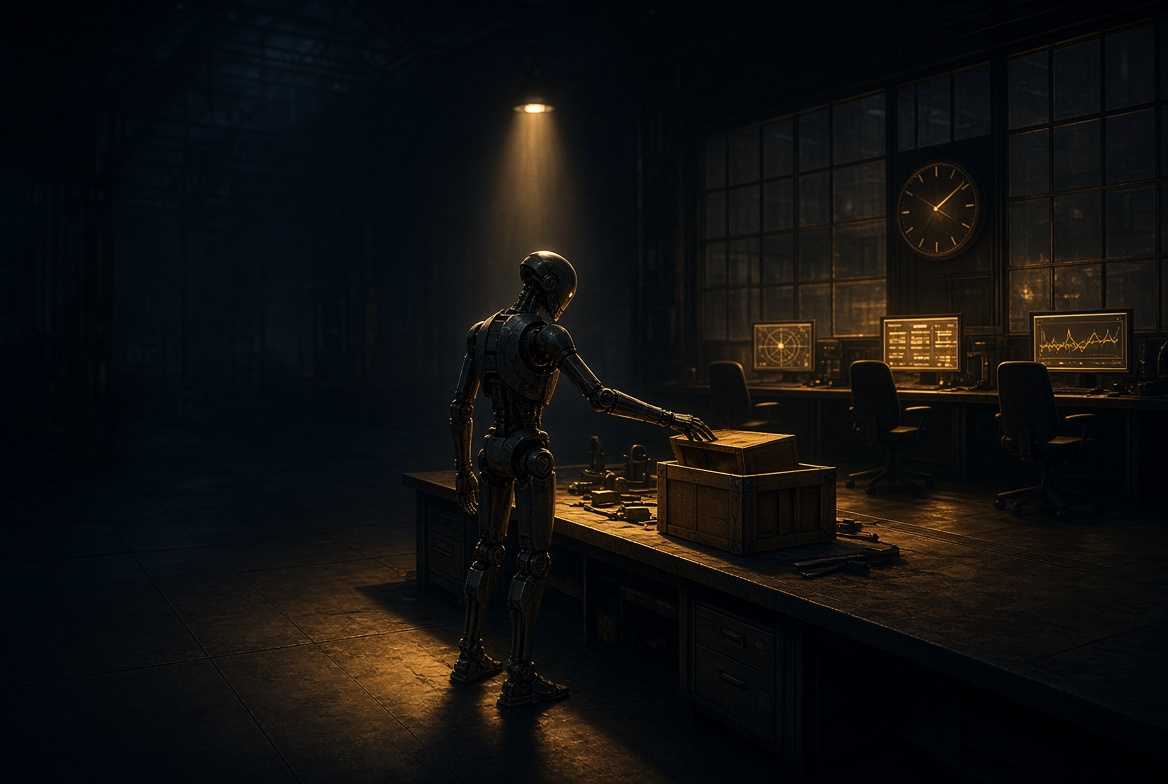
Samsung is testing a humanoid designed to run around the clock, according to a JoongAng Ilbo report carried by Korea JoongAng Daily on 20 October. The robot is being trialled at the company’s R&D campus in Seoul’s Umyeon-dong, moving goods in the repetitive way factories and warehouses like. Samsung has not confirmed the details. The report rests on unnamed industry sources and says the machine is only “under consideration” for a CES 2027 showing.
The detail worth keeping is the staffing. One of those sources says Samsung and partner employees monitor the robot “around the clock in three shifts”. A machine that never clocks out, then, currently needs a rota of people to watch it not clocking out. That is not a gotcha. It is what an early trial looks like. It is also the number missing from every 24/7 claim in the sector: how many humans per robot-hour, and for how long.
The uptime itself is the real advantage on offer. Samsung’s own March strategy statement says it will move all its manufacturing to “AI-driven factories” by 2030 and “progressively” introduce humanoid and task-specific robots on production lines, in operating, logistics and assembly roles. It gives no figures: no robot count, no investment, no productivity gain. The only number in it is the year.
The competitors show why uptime is a battery question as much as a labour one. The same report puts Atlas at roughly four hours in normal conditions before an autonomous battery swap of about three minutes, and says UBTECH’s Walker S2 carries two batteries and swaps in about the same time while being promoted for 24/7 operation. Industry observers suggest Samsung may use hot-swapping too. That is speculation, not a Samsung plan.
Samsung’s own robotics lead was candid about the gap. Kris Hauser, head of its Robotics Lab, said at the Samsung AI Forum that the company may have entered robotics later than rivals and that profitable general-purpose robots are a long-term challenge. Samsung’s RX division only dates from July.
The case for. Factories already run three shifts because machines are expensive to leave idle. A humanoid that fits human-built workstations and works through the night would put that logic into spaces nobody wants to redesign. Samsung also has its own plants as a test bed and says it will collect real operating data there first.
The case against. An unnamed-source report, a prototype and a CES maybe. No cost, no robot count, no launch date, and no figure for how much of the monitoring will fall away once the robot works unobserved. Round-the-clock operation with round-the-clock supervision is a different economic proposition from the brochure.
Two truths. The capability being built is real: a robot that swaps its own battery and keeps working is worth more than one that stops every four hours. The thing being sold on top of it is the idea that nobody has to be there. Until the monitoring rota shrinks, it is not unmanned, just differently staffed.