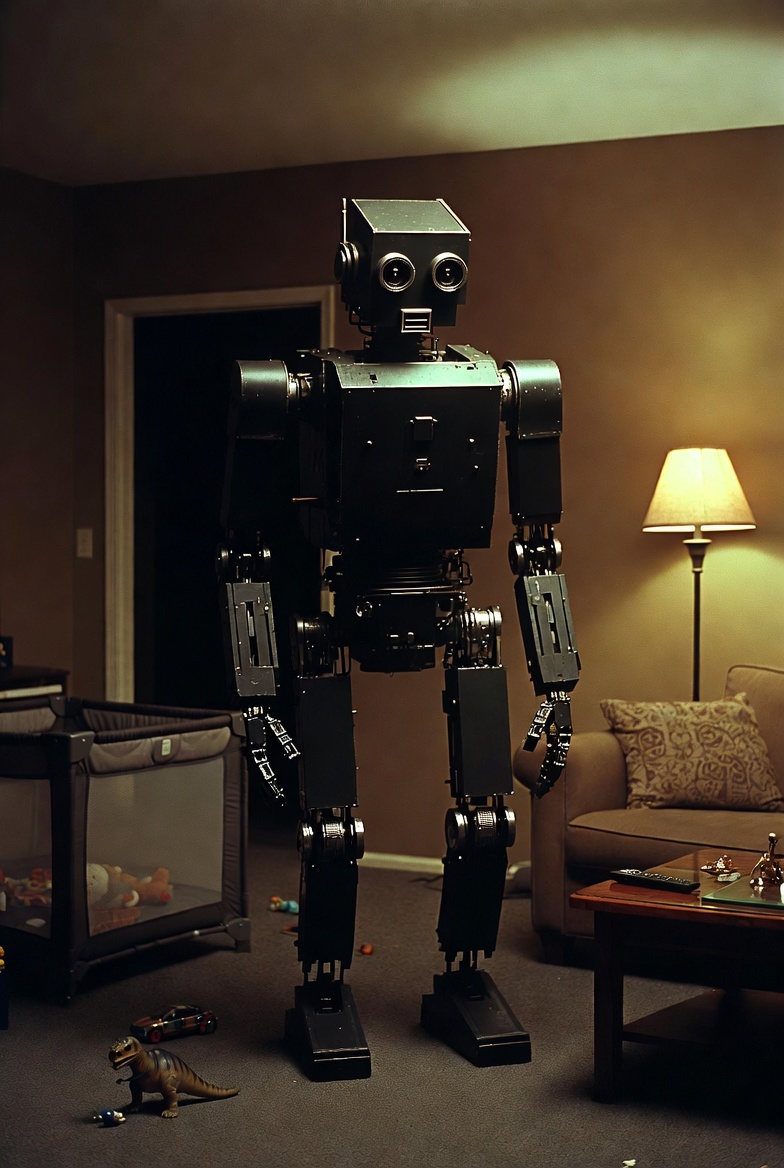
On 17 June, a three-foot robot called Codey was suddenly everywhere. USA TODAY ran a video feature under the headline that it “could one day babysit your kids,” and within hours the same package had propagated across the Gannett network — the Ventura County Star, the Herald-Mail, dozens of local mastheads running identical wire copy and the same footage. To a casual scroll, it looked like a humanoid robotics company had just announced something.
It hadn’t. Codey has existed publicly since December 2025, and its maker, the Seattle startup Mind Children, has been working on it for roughly two and a half years. What happened on 17 June was a media event, not a product one: a single produced video, syndicated at scale. Worth keeping in mind the next time a robot “breaks through” — sometimes the only thing that broke is a publisher’s decision to press play.
So what is actually there, behind the headline?
A child-sized social robot, about 90cm tall, with glowing hazel eyes and animated facial expressions, built to hold a conversation and navigate a room without a human operator at the controls. That last part is a genuine distinction from the teleoperated humanoids that dominate viral demo reels — Codey is designed to run autonomously. The intended settings are classrooms, care homes, hotels and museums, and the company is explicit that the pitch is emotional rather than physical: a robot children want to talk to, not one that fetches your coffee.
Which is fortunate, because it can’t fetch your coffee. By the company’s own account, Codey cannot yet perform complex physical tasks such as picking up objects; one of its stated near-term goals is to learn to press a button. The conversational intelligence everyone reacted to runs on OpenAI’s large language models on the backend — capable, but off-the-shelf, and not the thing the marketing foregrounds.
That marketing is where the story earns a second look. Mind Children was co-founded by Ben Goertzel — the SingularityNET founder who did more than anyone to popularise the term “AGI” — and Codey was spun out of SingularityNET’s research. The company describes the robot as built on the Hyperon decentralised AGI framework, “capable of progressively increasing in general intelligence” and possessing the ability to “continuously expand their general intelligence over time.” Set that beside a sub-one-metre prototype that runs on someone else’s chatbot and is working towards pressing buttons, and the distance between the vocabulary and the hardware is the whole story.
The funding picture matches the modest reality rather than the cosmic framing. Mind Children is filling out a sub-$1m crowdfunding campaign — past $600,000 of a $1m target at the time of writing — and plans pilot studies this year in museums, hotels and galleries, with a second-generation Codey slated for 2027. These are early-stage, gather-the-data numbers, not the nine- and ten-figure rounds flowing to the warehouse-humanoid companies.
To the company’s credit, it is candid about the parts that should worry people. Co-founder and CEO Chris Kudla says the team is deliberately steering clear of the uncanny valley, and reports that the blunt public verdict is often that the robot is creepy — though rarely, people are at pains to add, in a bad way. On safety, Mind Children says it does not intend to capture and transmit classroom video, and that it has stress-tested the robot against attempts to bait it into inappropriate behaviour, including users posing role-play scenarios to make it act as a bully. For a product aimed at children and the elderly, that those questions are being asked at the design stage is the right instinct, whatever one makes of the AGI branding.
None of this makes Codey a fraud, and the sceptical read is not that social robots are a bad idea — there is a real, under-explored argument that the hard problem in robotics is emotional plausibility rather than dexterity, and Mind Children is at least pointing at it. The point is narrower: a robot that cannot lift a cup became a one-day news cycle about babysitting children, on the strength of a video and a famous name attached to the word “AGI.” The capability is small and honest. The framing around it is neither. Telling those two things apart is, increasingly, the whole job.