Why one ordinary kitchen task tells you more about home robotics than any production figure
A humanoid robot that can reliably load a dishwasher in a kitchen it has never seen before is a long way past anything shipping in 2026. Not years away because of cost, and not because the hardware isn’t ready — but because the task hides a stack of unsolved problems behind its apparent dullness. This is worth dwelling on, because the dishwasher is exactly the sort of thing the home robot is always about to do, in roughly the same way it has been about to do it for the past decade.
Why a dishwasher, and not “the home”
The broad question — when will we have a robot in our homes? — is almost useless, because it lets everyone answer with their own optimism. Loading a dishwasher is better. It’s bounded, it happens daily, everyone understands it, and it quietly touches nearly every open problem in embodied robotics. It looks like a chore. It is in fact a fairly complete exam.
The case for the pessimism is easiest to make by simply walking through it.
Walking the task
Consider what a person does, without thinking, in about ninety seconds.
They look at the scene. A counter of unfamiliar objects, overlapping, some half-behind others, a few not even dishes. Recognising novel objects in clutter — not the specific bowl the system trained on, but this bowl, in this light, with a smear of something on it — remains genuinely hard. The demo footage that works so well tends to feature objects the robot has met before, arranged considerately.
They decide what goes in. Plate, yes. Mixing jug, yes. Wooden spoon, probably not. Good knife, absolutely not, and a human knows this without being told. The robot needs that judgement to generalise far beyond what it was shown, which is precisely the thing current systems are worst at.
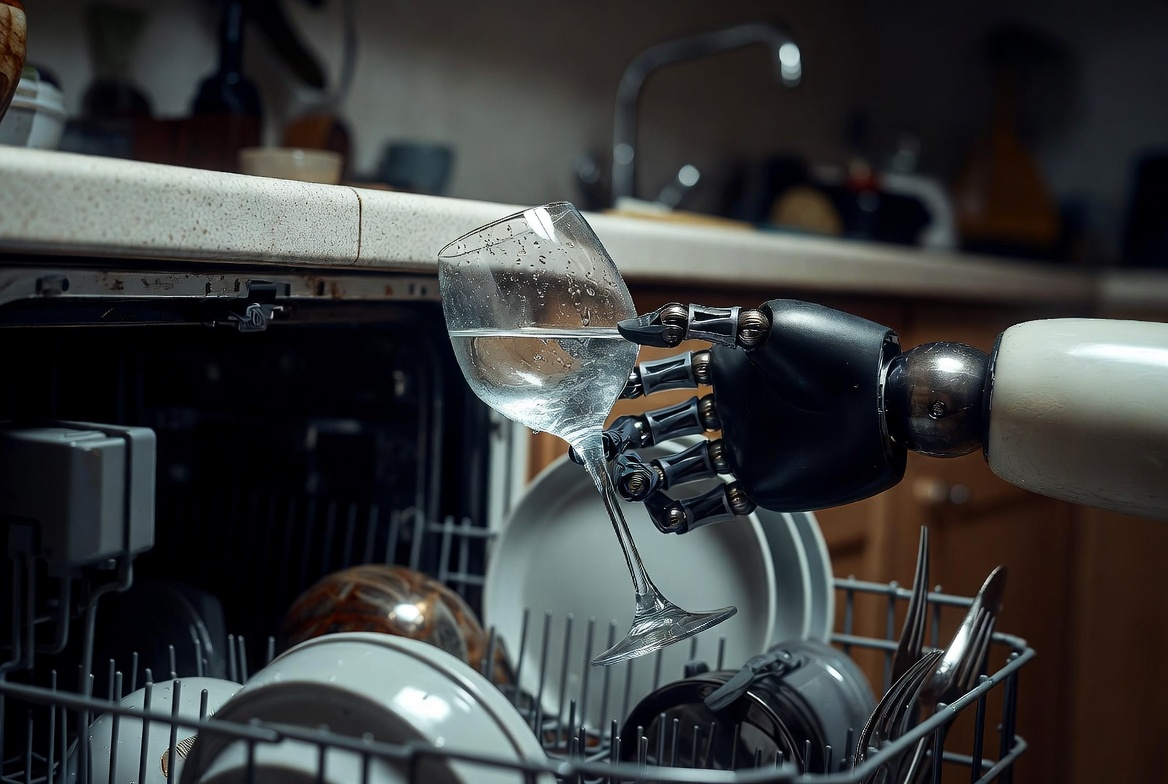
They pick the thing up. Wet, slick, varied in shape, occasionally fragile. Handling slippery and deformable objects at reliable grip force is unsolved at the level of “every time, unsupervised, in your actual kitchen.” This is where the wine glass in our featured image quietly gives the game away — it’s being pinched by the bowl, the sort of grasp that looks confident in a still photograph and ends in broken glass in a real one.
They plan the load. An efficient, non-colliding arrangement that the machine can actually wash — tall things at the back, nothing blocking the spray arm. That’s spatial reasoning and planning, not a lookup table, and it changes with every load.
They recover when it goes wrong. A glass slips, a plate seats badly, the door of the rack won’t close. A person corrects instantly and barely notices. A robot needs that failure to have been anticipated, or it simply continues, serenely, into the error.
Each of these is demoable on its own. None of them is reliable in combination, in a room the robot hasn’t seen. That gap — between “can be shown” and “can be trusted” — is the whole story.
The controlled-environment trap
This is where the 2026 production news is worth holding up to the light. The impressive footage — the factory humanoids, the warehouse pick-and-place, the carefully staged kitchen — works because the environment has been built around the robot. Fixed lighting, known objects, repeatable layout, a film crew with an interest in the take going well.
The home is the precise opposite. It is unstructured, it varies hourly, and it is actively rearranged by the people living in it. The mass-production milestones now arriving — Xpeng’s IRON line, Figure’s ramp, the various Nvidia partnerships — are real, and they solve a real problem. That problem is unit cost. It is not the same problem as usefulness. You can build a million of something that still cannot be trusted to put away a wine glass, and on current evidence, you would.
Why “two years away” never moves
The estimate is remarkably stable. Home humanoids have been roughly two years away for long enough that the phrase should probably be retired, or at least charged rent.
The reason it doesn’t move is that the hard part isn’t on the curve that’s improving. Hardware gets cheaper and better on a fairly predictable schedule. What doesn’t improve on that schedule is robust generalisation to messy, unfamiliar, physical environments — the ability to do the right thing with an object you’ve never encountered, in a space arranged by someone who wasn’t thinking about you. That capability is advancing, but slowly, and unevenly, and it is the binding constraint. As long as it remains the binding constraint, the headline figures — cheaper actuators, more units, new partnerships — can keep improving without moving the date at all.
The honest version
So here is the assessment, without the prediction theatre. Reliable, unsupervised manipulation in an ordinary home is a different class of problem from the one being solved in the demos, and the distance between them is structural rather than incremental. It will close. It is not closing on the timeline the production figures imply.
The thing to watch for, then, isn’t a better demo — there will be many, and they will be impressive. It’s the unglamorous milestone: a humanoid handling a task it was never shown, in a kitchen it has never seen, and getting the wine glass into the rack in one piece. On the day that happens reliably, the two years will finally start counting down.