Ask why a robot needs legs and you will be told about stairs. It is the first answer, it is intuitive, and it is very nearly worthless.
Stairs are real. Bipedal machines climb them and wheeled machines do not, and Zhou Xingyou, chairman of PI Robotics, will tell you plainly that bipeds hold the edge on uneven surfaces, slopes and steps. He will then tell you that inside a factory this hardly matters. Warehouses and plants are flat. They are flat because insurers and occupational safety regulators spent decades making them flat, and a facility with a step where a robot might trip is a facility with a step where a person might fall. The obstacle course the humanoid was built to conquer was demolished before it arrived.
Puzhi Robotics, a joint venture involving AgiBot, has shipped around 200 robots. Sixty per cent of them are wheeled. Its bipeds run 500,000 to 600,000 yuan; the wheeled models, 400,000 to 450,000. Buyers are being offered legs at a premium of roughly a hundred thousand yuan, and in the majority of cases they are declining.
This publication has spent months noting that the humanoid form is frequently a costume — that Genesis and Robot.com both dropped legs deliberately, that the wheeled base is faster, cheaper, more stable and vastly easier to control. All of that holds. It is precisely why the question of where the humanoid genuinely wins is worth asking properly, rather than answering it with a photograph of a robot on a staircase.
The floor is not the problem
The strongest case for the human form has nothing to do with getting anywhere.
Jiang Lei, chief scientist at China’s National and Local Joint Humanoid Robot Innovation Center, puts it in one number. Wheeled positioning accuracy is centimetre-level. Industrial manipulation frequently demands sub-millimetre to millimetre precision. A wheeled base cannot deliver it, on his account, because it cannot provide a perfectly stable reference point — it is always, at some tolerance, free to roll.
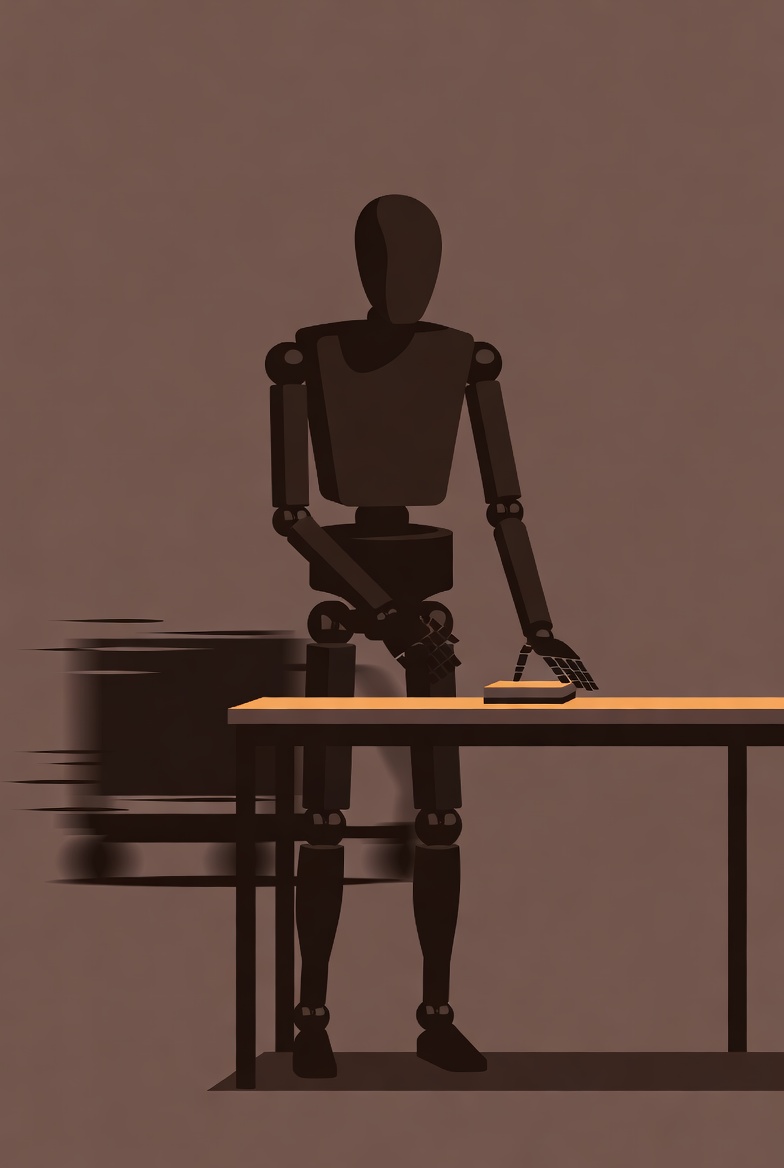
A biped standing on two feet is doing something a wheeled robot structurally cannot: it is anchored. Feet planted, weight distributed, the machine has converted itself from a vehicle into a fixture. The arms then work against a frame that does not move. This is not an argument about locomotion. It is an argument about what happens after locomotion stops.
Put another way: the legs are not for travelling. They are for standing still. Wheels are a better way to cross a room and a worse way to occupy one.
The corollary is that the humanoid’s advantage appears precisely where the task is fine, static and performed at a fixed point — a workbench, an assembly jig, a bin face — and evaporates wherever the task is moving things from A to B across a clean floor. Which is, uncomfortably for the sector, most of what a warehouse does.
The advantage nobody demos
The second advantage is not mechanical at all. It is a line on a spreadsheet.
Conventional automation is greenfield. You buy the robot, then you rebuild the building around it: fixed conveyors, caged cells, guided paths painted on the floor, racking respaced to the machine’s turning circle. The robot is cheap; the facility is not. A legged humanoid is a brownfield proposition. It walks into the plant as it stands, uses the aisles that exist, reaches the shelves that exist, and requires no floor to be lifted.
Ask any manufacturing or logistics operator when the good time is to take a worksite offline for six months. There isn’t one. The humanoid’s real competitive advantage over both the wheeled AMR and the fixed industrial arm may simply be that it costs comparatively little to try. Anthropomorphism is not, on this reading, a feature of the robot. It is a feature of the building — of doorways sized for shoulders, handles set at hip height, shelves reachable by an arm on a torso that bends. The world is a fixture designed around a body. The machine that shares the body inherits the fixture for free.
That is a genuine, quantifiable, unfashionable advantage. It shows up in installation cost and downtime, and it never appears in a launch video, because a robot walking into an unmodified warehouse and beginning work looks like nothing at all.
What this does not license
None of this rescues the general case. It does the opposite: it draws the boundary tightly.
The humanoid wins on precision manipulation from a fixed stance, and on deployment into buildings already shaped for people. It loses on transport, on speed, on energy, on cost, on reliability, and on very nearly every metric where the wheel has had four thousand years of development. Where a task is flat, repetitive and about moving mass across a floor, the correct machine has wheels — and the market appears to know it. Sixty per cent of Puzhi’s shipments say so.
The legs earn their keep in the seconds after the walking stops. The rest of the time they are a hundred thousand yuan of liability with a sophisticated balance controller attached, and the industry’s own scientists are among those saying so.
Two things are true. The humanoid form has a real, defensible advantage. And it is not the one the demos are selling. Stairs make the better video. Standing still makes the better robot.