Mitsubishi Motors and a robotics startup called Highlanders signed a memorandum of understanding on 9 July. The company will explore deploying humanoid robots in its own factories, and will examine the feasibility of mass-producing Highlanders’ robots at its Kyoto Plant from early 2027. The planned capacity is a thousand units a month. Mitsubishi Motors has already invested in Highlanders and says it intends to invest more.
The headline that ran everywhere was that a carmaker is going to build a thousand humanoids a month. The press release says something narrower. It says the two companies will explore joint development, and will examine the feasibility of commencing production. Those are not the verbs of a company that has committed to a production line. They are the verbs of a company that has agreed to find out whether one is possible.
That distinction matters more than it usually would, because of who is on each side of it. Highlanders was founded in 2023 and employs forty-six people. Its robot is called N: roughly human height and weight, walks, manipulates objects, runs a physical-AI stack that turns camera and sensor input into autonomous action. What Mitsubishi Motors brings to the table is listed in the release with unusual precision — mass-production engineering, quality assurance, durability and safety design, integrated mechatronics control, factory operations. Read that list again and ask which direction the expertise is flowing. A forty-six-person startup has just acquired, on paper, the manufacturing competence of a company that has been stamping and assembling metal for seventy years. Mitsubishi Motors has acquired an equity stake and a robot to test.
This is a contract-manufacturing agreement with a humanoid standing next to it at the press conference.
The deployment side is where the release gets quietly self-defeating. Mitsubishi Motors will test-deploy several dozen robots. The Kyoto Plant is described as the leading candidate site, and the reason given is that its engine assembly lines contain many processes that can be performed without significant posture changes.
That is a remarkable sentence to include in an announcement about humanoid robots. The entire argument for a bipedal, human-proportioned machine is that it can do the things a fixed arm cannot: crouch under a chassis, reach behind a bulkhead, climb a step, twist. Posture change is the product. Mitsubishi Motors has looked across its own factories, identified the work where posture change is least required, and nominated it as the place to begin. The robot is being sent to the one station where its defining capability is surplus to requirements.
There is a defensible engineering reason for this, and it is not a flattering one. Standing still and reaching is what these machines can currently do reliably. Everything else is demo footage. Choosing the task the robot can already perform is how you get a pilot that does not embarrass anyone. It is also how you learn nothing about whether the humanoid form was ever necessary — because a wheeled arm on a rail would clear that same station without the balance problem, the fall risk, or the battery penalty of carrying a torso around.
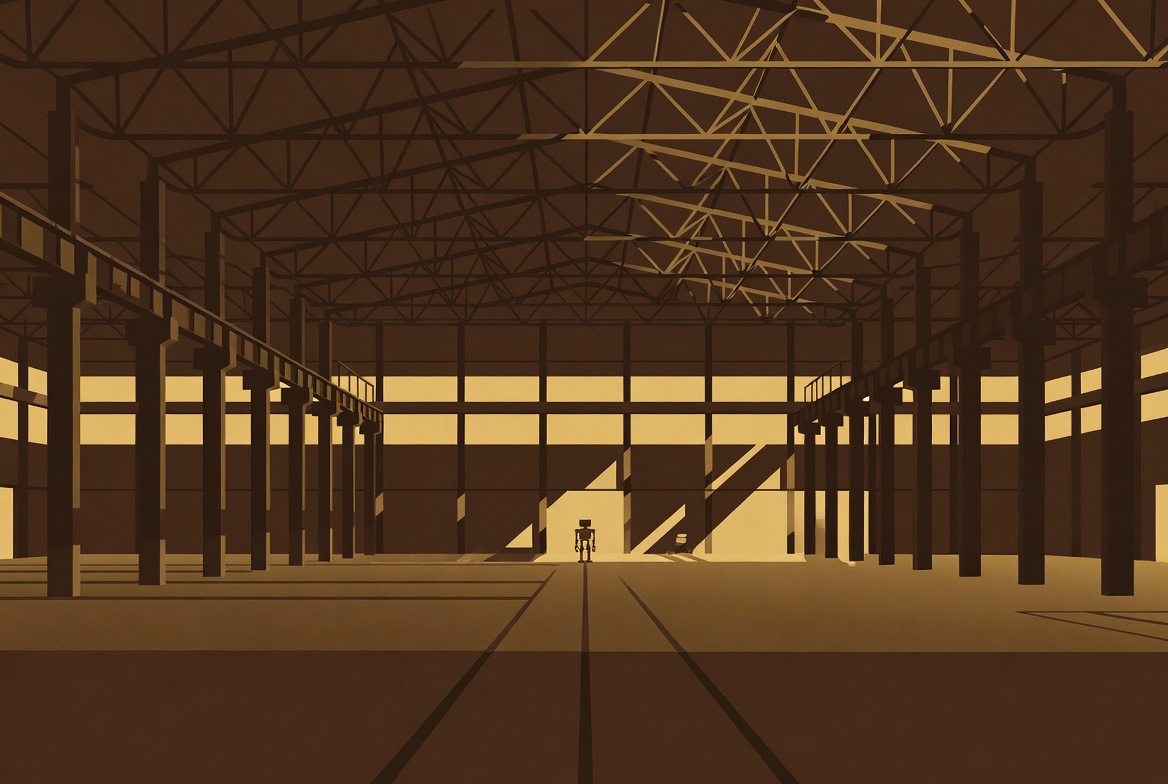
Then there is the building. The production line, if it happens, goes into currently unused buildings at the Kyoto Plant. Mitsubishi Motors is a carmaker with spare floorspace at an engine plant, in a country whose vehicle production has not recovered its old volumes and whose engine plants are being outrun by electrification. The site is available because the work that used to happen there does not any more.
There is a tidy symmetry in that, and it is worth resisting the temptation to make it too tidy. The labour shortage Mitsubishi Motors cites is genuine and structural; Japan is short of factory workers and will be shorter every year. The manufacturing competence it brings is genuine, and it is scarce — the constraint on humanoid robotics has never been demo videos, it has been the ability to build ten thousand of anything to automotive tolerance without the tenth thousand being worse than the first. Whoever solves that gets to matter. Mitsubishi Motors has solved it, for cars, at least.
Both of these are true at once. A company with the industrial skill the humanoid sector desperately lacks has agreed to lend it to a three-year-old startup, and has picked, as the proving ground, the corner of its factory where the robot’s most expensive feature is least needed — in a hall that emptied because the last generation of automation already did its job.