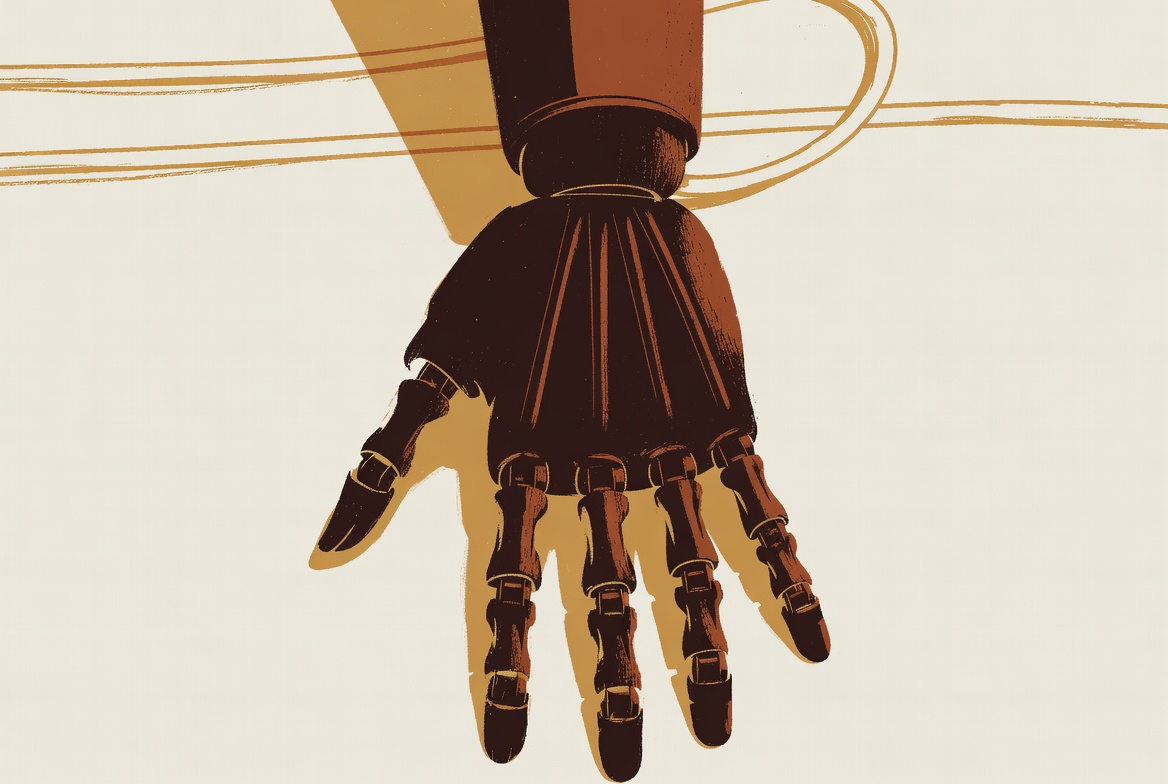
For seventy years, robotics worked around the hand. Grippers, suction cups, two-fingered pincers, purpose-built end effectors bolted onto arms that would never do anything else. The hand was the hard part, so the industry designed factories where hands were not required. It worked. It is still working. Most of the robots earning money today have nothing resembling a finger.
The humanoid bet reverses that. If you are building a machine shaped like a person, to work in rooms built for people, using tools designed for people, then the hand is not an accessory. It is the entire proposition. 1X founder Bernt Børnich put it plainly on Wednesday: the humanoid bet lives or dies at the fingertips.
On 9 July, 1X announced hands for its NEO humanoid that look, on the specification sheet, like the strongest attempt anyone has made at that problem.
What was actually built
Twenty-five degrees of freedom: twenty-two fully actuated in the fingers and palm, three at the wrist. The degrees are distributed anatomically rather than evenly, biased toward a thumb that genuinely opposes the fingers — which is the difference between a hand and a claw.
The interesting number is not twenty-five. It is the gear ratio.
Most robotic hands run gearing of 100:1 or 200:1. That gearing buys strength, and it costs feeling. Contact force gets swallowed in the gear train before it ever reaches the motor, so the hand cannot tell you what it touched. You command a position, the finger goes there, and nothing comes back. The hand is effectively numb.
NEO’s hand runs quasi-direct-drive tendons at roughly 5:1 to 15:1, with the motors sitting in the forearm and pulling cables through the wrist. Every one of the twenty-five joints is force-controlled and fully backdrivable. Push a finger and it yields, and reports how hard you pushed. 1X calls this force transparency: the same physical path carries force outward and information back. Tactile skin across the fingertips measures pressure, contact location and shear. The whole assembly is IP68-sealed and built from food-safe materials, so it can be washed. Positioning accuracy is quoted at ±0.2mm. Peak thumb torque at the CMC joint is 3.5Nm.
The demo reel shows the hand assembling Lego, picking a screw off the floor, lifting a nine-kilogram kettlebell, installing a light bulb, and pulling grapes off a stem. Hundreds have been built. 1X says it has capacity for ten thousand this year — which is not a research figure. That is a manufacturing figure.
None of this is soft. It is a serious piece of engineering, and the sceptical move here is not to pretend otherwise.
The sentence to read twice
1X’s own announcement explains what the hands are for. They are designed, it says, to remove the hardware ceiling on what humanoid robots can do, and to make data the only barrier to capability.
Read that again as a business statement rather than a technical one.
For three years, every humanoid company has had the same available explanation for why its robot cannot yet do the thing in the video without a person behind it: the hardware is not ready. It was a good explanation, because it was true, and because it was falsifiable on a timeline that always sat comfortably in the future. Hands are hard. Everyone knew hands were hard. Hands bought time.
1X has just spent that credit. It has declared, in its own launch copy, that the hardware ceiling is gone and that only data remains. It has moved its goalposts to the one place where it has no proof, no public benchmark, and no stated timeline.
Because the constraint the hands do not address is the one NEO shipped with. NEO is a $20,000 home robot with roughly ten thousand pre-orders since its October 2025 launch, and its capabilities in an unstructured home currently depend on a remote human operator who can take the controls. That teleoperator is how the data gets collected. The hand is the instrument; the human is still the musician.
A better instrument does not make the robot autonomous. It makes the recordings better. Twenty-five backdrivable, force-transparent, tactile joints are, among other things, an extraordinarily high-bandwidth sensor for capturing exactly what a human driver does with their fingers inside your kitchen. 1X’s own framing — an API to the physical world — is more candid than it perhaps intended. An API is something other software calls.
What to watch
The claim to test is not dexterity. The videos are the videos, and they are good.
The claim to test is the implied one: that with the hardware ceiling lifted, capability now scales with data. That is a hypothesis, not a result. It predicts something specific and checkable — that NEO’s rate of autonomous task completion in real homes should now begin climbing, and that 1X should be willing to publish it. Watch for a figure. Watch for whether the teleoperator hours per household fall over the coming year, and by how much. Watch, especially, for whether 1X ever says out loud what fraction of a NEO’s working day is currently driven by a person in an office.
Nothing about the hands makes that number better. Everything about the hands makes it harder to avoid the question.
Two things are true. 1X has built the most capable robotic hand that has ever been attached to a humanoid, and it is not close, and the engineering deserves the attention it is getting. And by building it, 1X has taken away the last excuse anyone had for why the robot still needs a human. The fingertips were never the bet. They were the place the bet could be deferred to. That place is now gone, and what remains standing in the kitchen is a twenty-thousand-dollar machine with superb hands, waiting to be told what to do.