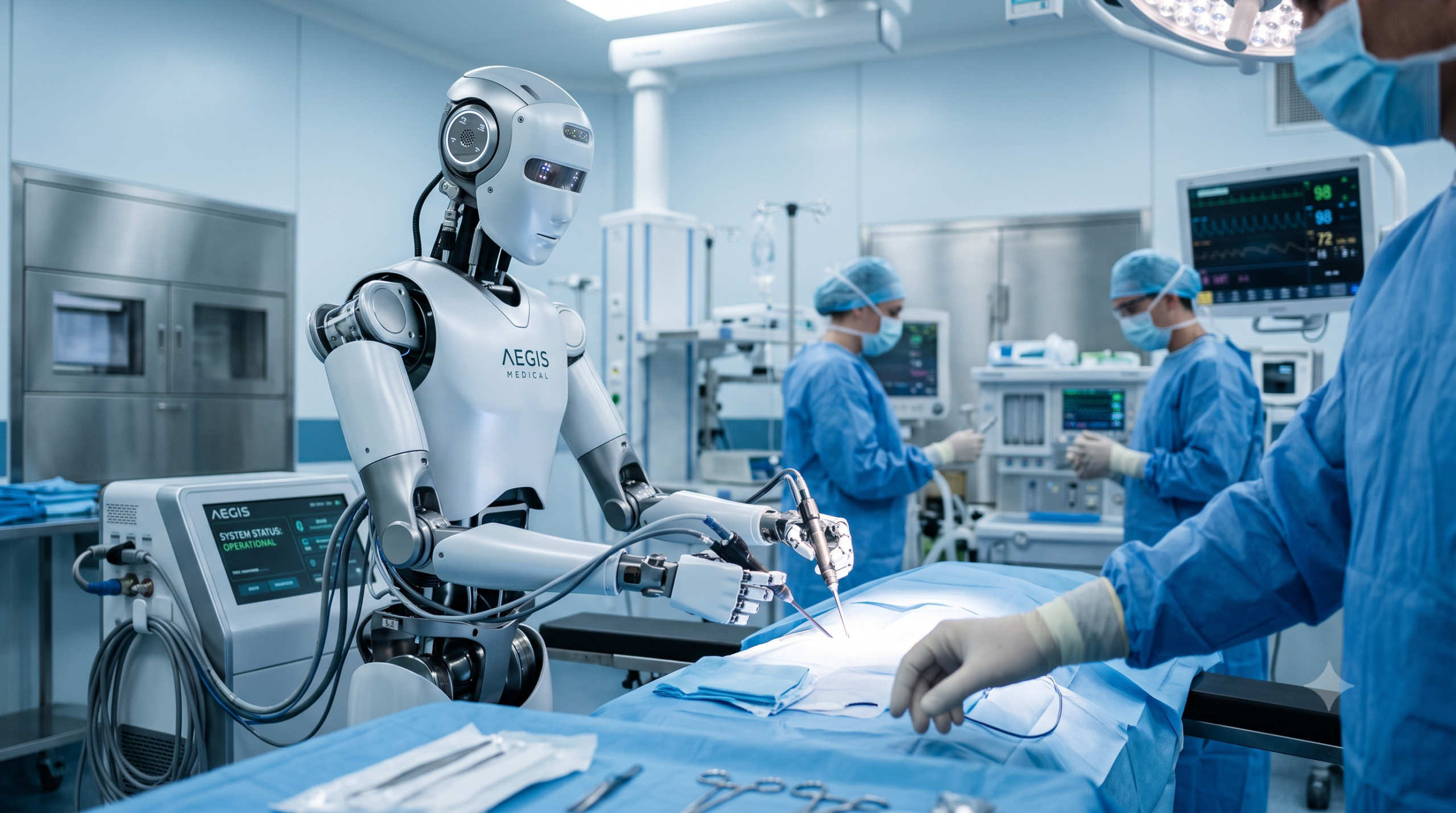
On July 8, a team of engineers and surgeons at UC San Diego published results in Nature describing something that sounds like science fiction until you read the details closely: humanoid robots performed surgery. Twice. On live pigs. Both procedures were gallbladder removals carried out by teleoperated Unitree G1 humanoids, fitted with laparoscopic-tool adapters — a world-first for humanoid-platform teleoperated surgery. One procedure paired a robot with a surgeon assisting bedside; the second was run by two of the humanoids together, with the operating surgeon controlling them remotely rather than standing at the table.
That “teleoperated” detail matters more than the headlines let on. This isn’t an autonomous robot making its own surgical decisions — it’s a human surgeon’s hands and judgment, projected through a humanoid body instead of exercised directly. The team has nicknamed the setup “Surgie.” Gallbladder removal is a routine, well-understood procedure, and a deliberately conservative choice for a first-of-its-kind trial — the point wasn’t to prove a robot can out-think a surgeon, it was to prove a teleoperated humanoid can stand in for one physically, in a real body, under real surgical conditions. “As a proof of concept, it absolutely worked,” said Dr. Ryan Broderick, interim director of UC San Diego’s Center for the Future of Surgery.
Why this isn’t just another surgical-robot story
Robotic surgery isn’t new — systems like Intuitive Surgical’s da Vinci have been in operating rooms for two decades, with a surgeon at a console doing the actual decision-making while the robot’s arms translate hand movements with more precision than a human wrist allows. What’s different here is twofold, and both differences matter for anyone tracking automation’s advance into skilled professions.
First, the form factor. Surgie is built humanoid — head, arms, roughly the footprint of a person — specifically because it needs to fit into the same physical space a human assistant would occupy. “The space constraints didn’t exist like in traditional robotic surgery,” Broderick said. “It was a human-type bedside assistant, so it just fit into the space that we’re traditionally used to being in for laparoscopic surgery.” That’s a deliberate design choice: build the robot to slot into existing infrastructure and existing roles, rather than requiring hospitals to redesign around it. That’s exactly the pattern that tends to precede rapid adoption in other industries — the technology that wins isn’t the most capable one, it’s the one that requires the least disruption to deploy.
Second, the decoupling of expertise from location. Because the surgeon is operating remotely rather than scrubbed in at the table, the humanoid form factor is what makes telesurgery portable to an ordinary OR instead of a bespoke robotic suite. Remote surgery itself isn’t new — surgeons have operated on patients continents away using fixed robotic consoles for years. What’s new is putting that capability into a general-purpose, human-shaped body that can be wheeled into any existing operating room and stand in the spot a bedside assistant would normally occupy.
The labor question underneath the headline
The researchers were candid about where they think this goes. Michael Yip, the UC San Diego professor leading the engineering side, said the team believes they’ve shown “it is possible to use humanoid robots in an operating room to do real procedures that can eventually save lives.” Dr. Shanglei Liu, a colorectal surgeon on the team, went further, describing a vision of Surgie deployed “on a ship, in a village somewhere, in a smaller operating environment that’s not in major cities” — precisely the settings where hospitals struggle to recruit and retain surgical staff.
That framing — solving a staffing shortage — is how automation is almost always introduced into a licensed profession: not as a replacement for the specialist, but as a way to extend care into places specialists won’t go, or to backfill roles nobody wants. It’s a genuinely sympathetic case, and probably a true one in the near term. But it’s worth remembering that “assist where there’s a shortage” and “replace where there’s a surplus” are two stages of the same technology, and the gap between them tends to close faster than the institutions built around the old arrangement expect.
Surgical robotics is actually a useful precedent here, and a mixed one. Da Vinci systems didn’t put surgeons out of work — they created a new, well-compensated specialty (robotic surgery certification) and, if anything, increased demand for surgeons trained on the equipment. But they did quietly reduce the number of assisting staff needed in the room, and they concentrated volume in hospitals that could afford the systems, squeezing smaller facilities out of certain procedures entirely. Because this system is teleoperated rather than autonomous, it doesn’t threaten the surgeon’s role directly — it threatens the requirement that the surgeon be physically present. One credentialed surgeon could plausibly cover a “ship, or a village somewhere,” in Dr. Liu’s framing, without traveling to any of them, which changes how many surgeons a given region actually needs on-site rather than how many surgeons exist.
The people most exposed here aren’t necessarily attending surgeons. It’s surgical techs, first assists, and residents — the bedside roles a teleoperated humanoid is explicit