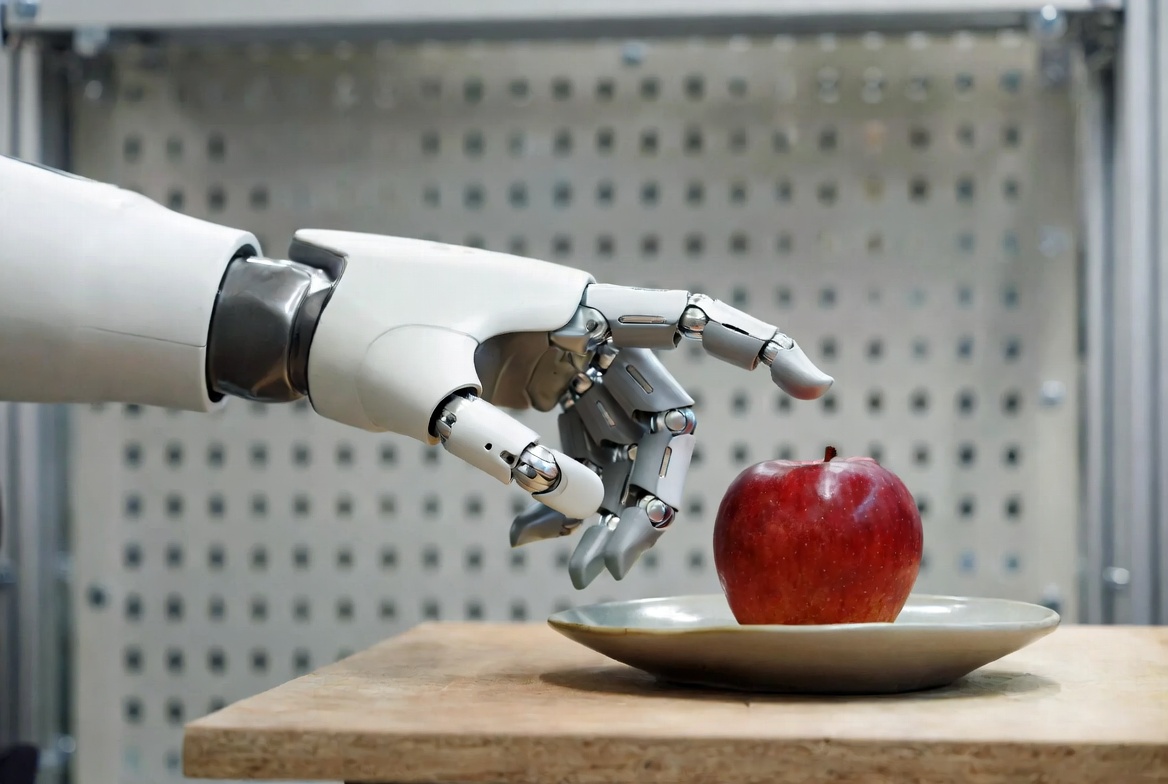
There is a video, and in the video a robot picks up an apple and puts it on a plate. It works. The success rate prints to the console as a clean, round number: 1.0. One hundred per cent.
This is the demonstration at the centre of NVIDIA’s newest announcement, and it is worth sitting with what it actually shows — because the gap between what happened and what it will be taken to mean is the whole story.
On 7 July, NVIDIA introduced the Isaac GR00T Development Platform: an open, end-to-end workflow that unifies every stage of building a humanoid robot’s behaviour, from setting up a simulation to collecting data, training a model, evaluating it, and deploying it onto physical hardware. Alongside it came GR00T 1.7, the newest version of NVIDIA’s foundation model for humanoid robots — pretrained, the company says, on roughly 32,000 hours of real human demonstration and ego-centric video, plus another 8,000 hours of simulation.
Two truths sit inside that release, and the publication has spent two previous pieces circling them. The first was about the safety layer — NVIDIA building the conscience. The second was about the training environment — the robot going to school inside NVIDIA’s simulation. This is the third, and it is the one where the loop closes.
What “end-to-end” actually means here
For years, the tools for building a robot’s skills existed in separate boxes. One company’s simulator, another’s data format, a third’s deployment runtime, all stitched together by hand. NVIDIA’s pitch with the GR00T platform is that it has removed the stitching. Setup happens in Isaac Lab-Arena. Data collection happens through Isaac Teleop. Training runs on GR00T 1.7. Evaluation goes back into Lab-Arena. Deployment ships through Isaac ROS onto a Jetson Thor chip inside the robot.
Every stage is NVIDIA’s. Every artifact from one stage feeds cleanly into the next because NVIDIA designed both ends of every handoff. That is the genuine engineering achievement, and it is real: fragmentation is a true cost, and developers do lose weeks to plumbing before they can build anything. A single, validated, open-source pipeline is a meaningful thing to hand the field.
It is also the completion of a structure. The first piece in this series argued that NVIDIA had made itself the safety layer. The second argued it had made itself the curriculum. This platform is the moment those stop being separate observations. A robot built this way is trained on NVIDIA’s model, in NVIDIA’s simulator, evaluated by NVIDIA’s benchmarks, and deployed onto NVIDIA’s silicon — and the seams between those stages have been deliberately dissolved so that using one stage pulls you toward the next. The list of companies already adopting parts of the platform is not short, and it is not obscure: 1X, Agility, NEURA Robotics, Schaeffler, and a dozen others this publication has covered on their own terms are now building inside it.
The apple is a recording of a person
Here is the part the announcement is quieter about.
The apple-on-a-plate policy was not reasoned into existence. It was learned by imitation. A human being put on a VR headset, took hold of two controllers, and moved the robot’s arms through the task — over and over, 400 times, across multiple sessions, until there was a clean library of demonstrations. Those demonstrations were converted into a training format and used to post-train the model. What the robot “knows” about moving an apple is a compressed statistical echo of a person doing it several hundred times.
This is imitation learning, and it is a legitimate, widely used technique. But it is worth being precise about what it is not. The robot is not perceiving a goal and working out how to achieve it. It is reproducing a distribution of human hand movements it was shown, in conditions close enough to the ones it was shown them in. NVIDIA’s own instructions are candid about the fragility of that dependency: the success rate, they note, depends on how closely the deployment environment matches the environment used during data collection. Move the plate, change the light, swap the apple for something the demonstrations didn’t include, and the number that was 1.0 has no obligation to stay there.
Which is the tension this whole series has been building toward. “Autonomy,” in the sense the word does its marketing work, implies a machine that decides. What the GR00T platform actually productises is a very efficient way to record human decisions and replay them. The 32,000 hours are not the robot’s experience. They are ours, captured and handed over.
About that 100 per cent
The clean 1.0 deserves one more sentence of scrutiny, because it is exactly the kind of number that travels.
NVIDIA’s own guide states plainly that the 600-step evaluation producing that figure is a quick smoke test — roughly a single episode. To get a success rate that means anything, the same document tells developers to run 100 episodes, or 1,000 for a stronger estimate. The 100 per cent, in other words, is one successful attempt, presented as a checkpoint that the pipeline runs end to end. It is not a claim about reliability, and the people who wrote it do not present it as one. But stripped of that context — as it will be, the moment it leaves the documentation — it becomes “NVIDIA’s humanoid hits 100% success.” Both statements describe the same event. Only one of them is true.
Distance to Trellis
Measured against Trellis — the publication’s frozen definition of a general-purpose home robot, scored across six axes from 0 to 5 — the apple demo sits about where you would expect a productised imitation-learning pipeline to sit: impressive as infrastructure, early as capability.
- Autonomy provenance (1/5): The policy is post-trained on 400 teleoperated human demonstrations. The behaviour originates in a person’s hands, not the robot’s reasoning.
- Environmental novelty (1/5): A single fixed scene — one shelf, one apple, one plate. NVIDIA states success degrades as the environment diverges from the collection conditions.
- Object generalisation (1/5): Trained on one specified apple asset and one plate asset. No evidence of transfer to unseen objects.
- Failure economics (1/5): The reported 1.0 is a single-episode smoke test; a representative rate is explicitly left to a 100–1,000 episode run not shown.
- Temporal honesty (3/5): To NVIDIA’s credit, the documentation is unusually honest about the smoke-test caveat and the environment-match dependency. The marketing framing around it is the problem, not the technical write-up.
- Task breadth (1/5): One static tabletop pick-and-place. The robot does not even walk during the task; a balance controller holds it still.
None of these are criticisms of the engineering. They are a description of where a genuinely useful development platform meets a genuinely hard problem, and the honest distance between them.
The two truths
The first truth: NVIDIA has built something real and useful. An open, integrated pipeline that lets a robotics team go from an empty simulation to a deployed policy without losing a month to incompatible file formats is a material contribution to the field, and the decision to release the model under a permissive licence is a real one. The fragmentation it solves was a real tax.
The second truth: the same act closes a loop around the entire industry. The company that supplies the simulator now also supplies the model, the benchmark, the deployment runtime, and the chip — and it has engineered the handoffs so that adopting any one stage makes the others harder to refuse. And the “autonomy” the whole stack produces is, for now, an extraordinarily sophisticated way to record a human moving an apple and ask a robot to do it again in the same light.
NVIDIA has closed the whole loop. The hands inside it are still ours.