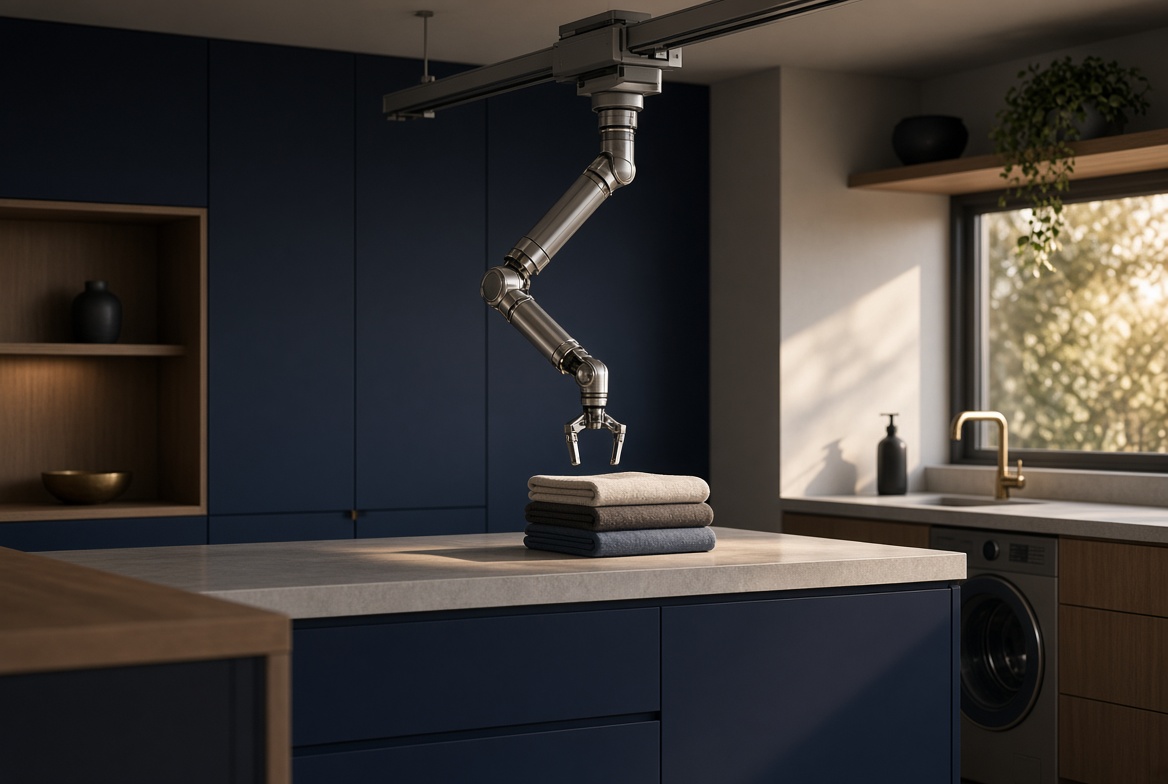
A Tokyo startup called MW is not building a humanoid. It is building houses — specifically, houses with robotic arms already mounted on rails in the ceiling and walls before you move in, ready to fold laundry or carry groceries along a fixed path from one fitted point to another. The first of these homes is due to go on sale in 2028. MW’s own target, reported by Bloomberg and confirmed independently elsewhere, is production of up to 10,000 units a year by 2035 — enough, the company says, to reach roughly 5% of Japan’s new-build housing market. CEO Shuzo Narita’s pitch is not that a general-purpose humanoid will eventually get good enough to do this job. It’s that the job doesn’t need one.
The engineering logic is almost boringly straightforward, which is rather the point. A humanoid doing housework has to solve a navigation problem — where the furniture is, whether the floor is clear, how to move through a space designed for a body shaped like a person without actually knowing that space in advance. An arm on a ceiling rail solves none of that, because it never has to. It goes where the rail goes, reaches what the rail lets it reach, and does one motion in one place instead of a general-purpose job everywhere. MW is betting that a narrower, dumber, permanently-installed machine will reliably fold your laundry years before a walking, seeing, reasoning humanoid reliably will — and that homebuyers will pay for the certainty of the first over the promise of the second.
This is the same wager this publication has already found evidence for twice this year: humanoids tend to win where the job requires a human-shaped body moving through a human-shaped world, and lose everywhere a fixed or wheeled machine can do the same task with less that can go wrong. A robot bolted into the ceiling before the drywall goes up is that argument taken about as far as it can go — MW isn’t competing on capability at all, it’s competing on the fact that its product cannot get lost, cannot fall over, and cannot need supervision, because it was never given the freedom to do any of those things in the first place.
The trade-off is exactly as obvious as it sounds. Ten thousand ceiling-mounted arms a year do not do the thing a general-purpose humanoid is actually being sold on — going anywhere, doing anything, adapting to a job nobody specified in advance. MW isn’t trying to win that argument. It’s building a smaller one, in a house you have to buy new to get, doing two or three chores extremely reliably instead of every chore adequately. Whether that’s a real alternative to the humanoid home robot or just a very literal admission of what the humanoid still can’t do depends entirely on how many buyers actually want the general-purpose promise badly enough to wait for it.
Two truths: a robot with no legs, no navigation problem and no ability to leave its rail can be more useful, sooner, than one that can walk anywhere but isn’t reliable yet — and building that certainty into the house itself, rather than into the robot, is itself a quiet verdict on how far general-purpose humanoids still have to go.