TechNode’s September 8 roundup — the second in a series on China’s robotics sector — profiles four companies it offers as proof the country’s humanoid boom has moved past demos into what the piece calls real jobs. The money behind that claim is specific and checkable: Zerith’s grasping robot, priced at roughly $29,000, has orders past RMB 100 million and a spot in Shanghai supermarkets since March. RobotEra is running logistics floors for China Post and SF Express across more than ten centers, with orders past RMB 500 million and something north of RMB 2 billion raised since March. Keenon, which has shipped over 100,000 robots to 70-plus countries, anchors an eight-robot service team at Shanghai’s Hongqiao Shangri-La that the hotel credits with cutting guest wait times by over a third. Digital Huaxia’s robots sit in more than 20 ICBC bank branches, backed by seed money from AgiBot, with RMB 100 million-level orders in year one.
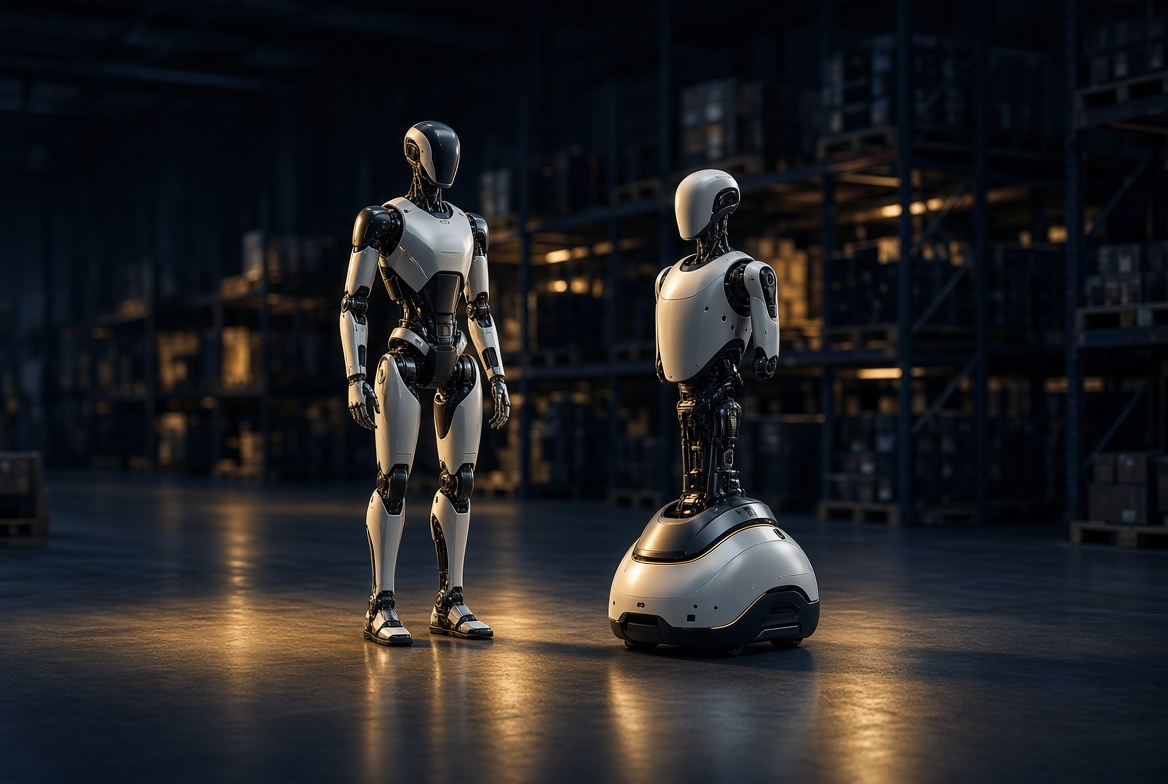
Read it once and it’s one story: humanoid robots, working, for money, at scale, four times over. Look at what each company actually builds and the story splits in half. Zerith’s H1 is a wheeled manipulation robot — a mobile base with grasping arms, no legs, no bipedal walk. It is a fine piece of automation and it is not a humanoid by any definition the term is supposed to carry. Keenon’s 100,000-unit fleet is, and has been since 2010, overwhelmingly the same thing: wheeled delivery and service robots rolling carts through hotel corridors. The humanoid share of its widely-covered Shangri-La deployment is one model, XMAN-R1, out of the eight-robot team the press release describes — the other seven are the specialized wheeled robots that were already Keenon’s business. Of TechNode’s four proof points, RobotEra and Digital Huaxia are the two actually building humanoids in the sense the category promises: legs, torso, general-purpose dexterity. Zerith and Keenon are real robotics businesses, with real revenue, wearing the word because it’s the word that gets the headline.
None of this makes the underlying deployment fake. RobotEra’s logistics contracts and Digital Huaxia’s bank branches are the two clearest cases in the piece of a humanoid, specifically, earning its keep — narrow tasks, named clients, orders that predate any press cycle. Keenon’s own efficiency numbers — the 30%, the 40%, the 35% — are the hotel’s and the company’s self-reported figures, not an independently audited study, and are worth exactly that much until someone checks; but Keenon’s underlying scale, 100,000 units shipped over more than a decade, doesn’t need those specific percentages to be a real business. The pattern here isn’t companies inventing revenue. It’s a category label doing more work than the machines wearing it, in both directions at once: genuine paid deployment, and a headline word that four different hardware forms all get to borrow.
This is the same splitting this publication has tracked before with export volume, where “China’s robot boom” mostly meant vacuum cleaners (Issue 021). This time it’s happening inside the domestic deployment numbers themselves — the ones being cited, right now, as evidence the humanoid category specifically has arrived commercially. A wheeled grasping robot and a fleet of hotel delivery carts are not evidence of that. They’re evidence that China’s robotics sector, broadly, is finding paying customers — a real and separate fact that the word “humanoid” is currently getting credit for.
Two truths: the revenue in this roundup is real — orders in the hundreds of millions of RMB, named enterprise clients, deployments running for months rather than a single demo day. And roughly half of the robots earning it aren’t humanoids at all. Both numbers are true at once, and the industry has no obvious incentive to be the one that points out which is which.