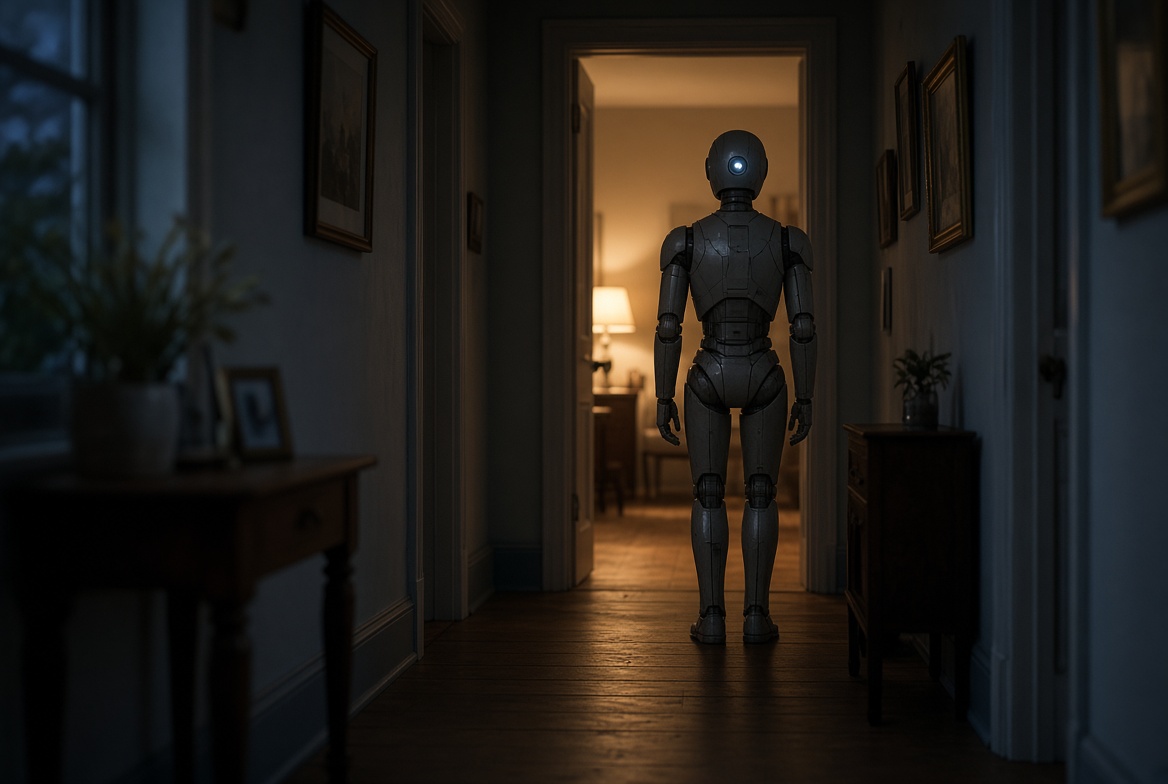
1X Technologies opened preorders this month for Neo, its consumer humanoid: $20,000 up front, or $499 a month if you’d rather subscribe to a robot than own one, against a $200 deposit to hold your place in line. Shipping begins in 2026. The company’s own account of what Neo can do by itself, unsupervised, is a short list — opening a door, fetching an object, turning a light on or off. Everything past that short list is, for now, done by a person.
That person is a 1X employee, working from a camera feed inside your house. The owner schedules a session through an app, states what needs doing, and a remote operator drives the robot through it — folding laundry, tidying a room, whatever the neural network hasn’t learned to do on its own yet. CEO Bernt Børnich has been candid about why, and about how much of it there is: “much of the work will be done by teleoperators in the beginning,” and the reason the company wants that work at all is that the robot’s own software “still needs to learn from more real-world experiences.” The teleoperation isn’t a stopgap being quietly tolerated. It’s the stated business model for how the autonomy gets built in the first place, on the explicit logic Børnich also gave for it: “if we don’t have your data, we can’t make the product better.”
1X has built real safeguards around this. Owners can mark rooms off-limits to the camera. Faces can be blurred in the video feed. Nothing happens without the owner scheduling and approving the session first. These aren’t cosmetic — they’re the difference between an unaccountable camera in your hallway and a documented, consented, bounded arrangement. But safeguards address who is allowed to watch and when, not the more basic fact underneath them: buying Neo today, at $20,000, means accepting that a person you have never met will, on a fairly regular basis, be looking through your robot’s eyes to do the job it was bought to do.
This publication has been running its own test for exactly this question since July — not a rigorous instrument yet, more a standing prompt: would you actually give this robot a spare key? Most of what’s been written under that banner has been about the robot’s own competence, or the lack of it. Neo reframes the question slightly. The thing being trusted alone in the house was never going to be only software. For the foreseeable future, at $20,000 a unit, it’s also whoever 1X has staffing the other end of the camera that week — a fact the company discloses plainly, which is more than can be said for the industry average, and which does not on its own make the arrangement less strange.
Two truths: the disclosure here is unusually honest, and the arrangement it discloses is unusually intimate. 1X is not hiding that a stranger may be watching your living room to make its product work. Whether that honesty is a point in its favour or just a clearer view of what every home-robot company is already doing quietly is the part worth sitting with.