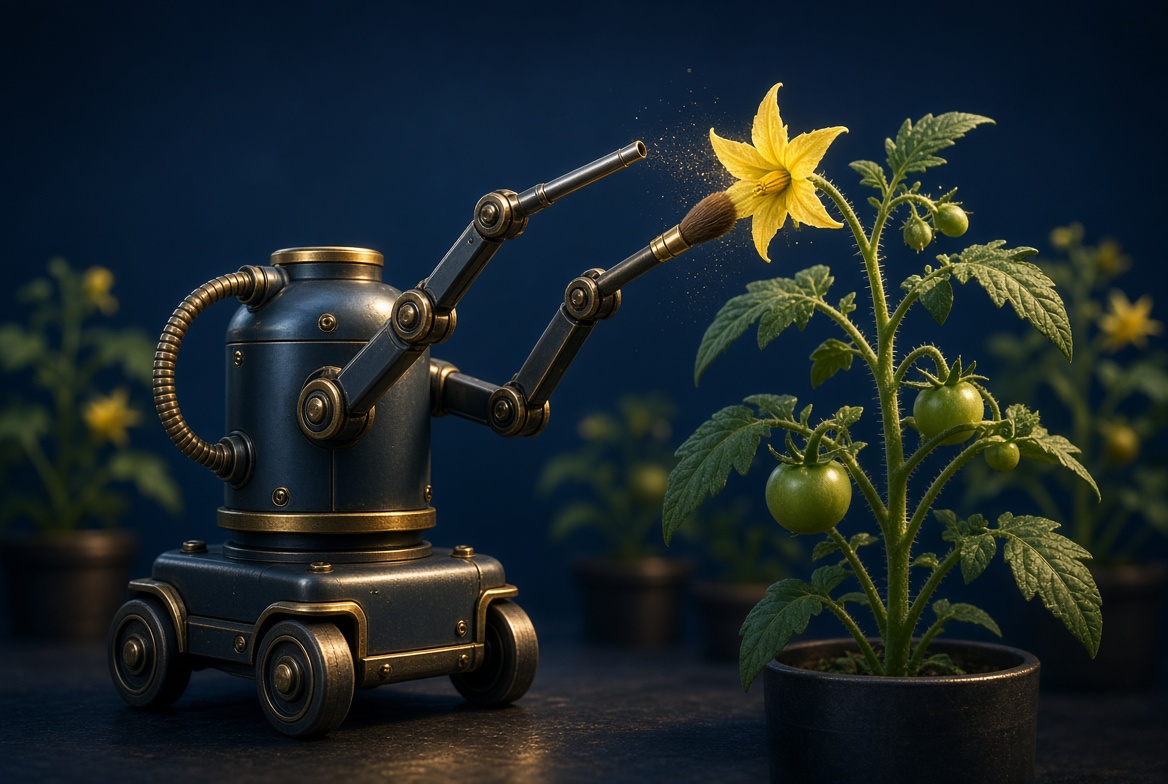
At the Beijing Seed Industry Conference on 8 September, a team from the Chinese Academy of Sciences’ Institute of Genetics and Developmental Biology unveiled GEAIR 2.0: a two-armed robot that holds a pollen tube in one hand and sweeps a fine brush in the other, pollinating a tomato flower in under ten seconds. A single dip of the brush carries enough pollen for roughly fifty more. Press coverage, Global Times included, calls it a humanoid robot. The demonstration photo shows a wheeled cart with two arms fixed to a stationary base, parked beside a row of potted tomato plants. No legs. No head. “Humanoid” is the word that gets an agricultural robotics story picked up outside the trade press, not a description of what’s actually standing in the greenhouse.
The genuinely interesting part happened upstream of the robot. GEAIR — Genome Editing combined with AI-based Robotics — didn’t teach a machine the dexterity to find a stigma buried inside an ordinary flower, the way a bee manages it. Led by Xu Cao, the team gene-edited the tomatoes instead: male-sterile plants bred with the stigma exposed and unobstructed, engineered specifically so a robotic arm could locate and reach it without needing the manipulation skill a real flower would demand. The method, published in Cell, is crop-robot co-design — reshaping the crop to suit the machine, not the machine to suit the crop. That is the actual achievement, and it belongs to genetics, not robotics.
Read that way, GEAIR isn’t evidence that robots are getting better at delicate manipulation. It’s evidence that biotechnology can lower the manipulation bar to whatever a robot can already clear. Useful — China’s hybrid breeding programmes stand to gain a faster, cheaper pollination step, and the same approach has already been extended to soybeans. But it says nothing about a robot’s ability to work with the world as it actually finds it, which remains the harder and more interesting problem.
Two truths: the ten-second pollination is real, and so is the fact that the flower did more of the adapting than the robot did.
Distance to Spare Key
Autonomy 1 · Novelty 1 · Objects 0 · Failure 0 · Temporal 0 · Breadth 1 → 3/30Moved by: nothing — no prior score exists to move against; this is the instrument’s debut. Read as a floor, not an indictment. Autonomy scores 1 because the coverage claims the robot operates “without continuous human control” but no outlet states whether a human was on hand at the conference booth — scripted-with-autonomous-segments, not stated-and-verified full autonomy. Novelty scores 1: a conference display, not a working farm. Objects scores 0 deliberately — the flowers were gene-edited specifically to be found and reached, which is the opposite of generalisation, and is also this project’s real achievement; the axis and the story’s point land on the same number for a reason. Failure and Temporal score 0 because no breakage/failure rate and no edit rate are disclosed anywhere in the coverage — unstated is zero, always. Breadth scores 1: pollination and “collecting data” are both named, separately, not as one continuous multi-task policy.